
A chipped plaster ornament or a broken candle detail can turn a promising order into wasted material and extra work. For businesses producing decorative pieces, mold selection affects surface quality, production speed, and the number of items customers will accept. Silicone Decorative Molds offer flexibility that helps release intricate shapes, including raised lettering, floral borders, and curved edges. Details matter. A clean impression can reduce finishing time, while easier release may help protect delicate features during demolding.
Still, choosing silicone is not an automatic guarantee of better results. Performance depends on the silicone grade, mold design, casting material, and conditions on your production bench. A deep floral cavity, for example, may trap bubbles unless the casting process allows air to escape. Thin sections can also tear when handled roughly, even when the material initially feels strong. Check the specifications. Suppliers should provide relevant information about temperature limits, material compatibility, and recommended care before you commit to a larger purchase. For candle production, check compatibility with your wax formulation and pouring temperature rather than relying on a general heat-resistance claim.
The business case becomes clearer when you compare cost per usable piece instead of purchase price alone. Record demolding time, rejected pieces, and visible wear during a small trial using your actual materials. A cheaper mold might perform adequately for occasional orders; a more durable option may suit repeated production. Neither choice is universally right, and early estimates of mold life can be optimistic. Examining these practical tradeoffs helps explain when Silicone Decorative Molds deserve a place in your business.
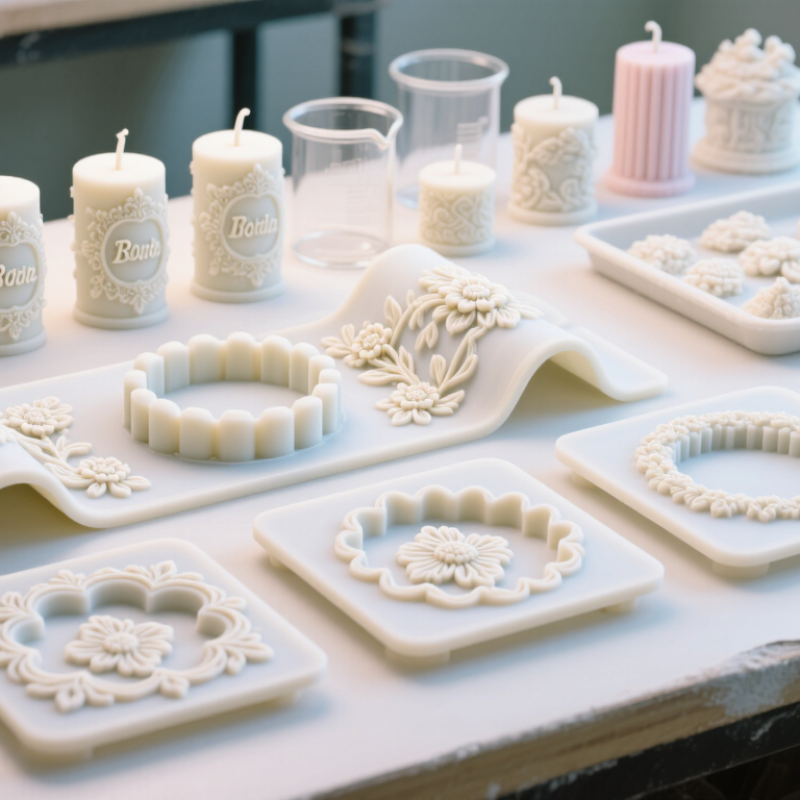
Silicone decorative molds are flexible tools that reproduce patterns in plaster, wax, resin, and similar casting materials. Think floral borders, textured panels, or small ornamental reliefs. To make one, liquid silicone cures around a master model, forming a flexible cavity that captures its surface details. The master is then removed. Your casting material fills that cavity and hardens before the silicone peels away. Details matter. Flexibility helps release curved edges and shallow undercuts, although delicate features still need careful handling.
The industry report “Silicone Market—Global Forecast to 2027” valued the wider silicone market at $18.5 billion in 2022. It projected growth to $27 billion by 2027. These figures cover multiple industries; they do not measure decorative molds specifically. For a workshop, material specifications offer more useful purchasing guidance than market size alone. Shore A hardness indicates firmness, while tear strength helps assess resistance around thin sections. Neither specification guarantees a particular number of casting cycles.
In practice, a leaf-pattern mold needs enough flexibility to release raised veins without breaking the finished casting. Pouring slowly into one area can help material flow through fine recesses. Still, sharp corners may trap air, and some casting materials require a compatible release agent. A softer mold may simplify removal but distort without adequate support. Test before scaling. There is no universal best hardness, and promising sample results may not predict performance across repeated production runs. Record rejected pieces, cleaning time, and visible wear when comparing options.
Fine lettering, floral veins, and recessed borders need silicone that flows into small features before curing. Published industry technical data sheets for addition-cure moldmaking silicones commonly list Shore A hardness values between 10 and 40. These figures describe cured hardness, measured using methods such as ASTM D2240. Softer grades generally release undercuts more easily; firmer grades better resist distortion during handling. Detail matters. For a decorative panel with narrow grooves, uncured viscosity also affects whether silicone reaches every recess without trapped air.
Selected addition-cure grades report linear shrinkage below 0.1% in their technical data sheets, although specifications vary. At 0.1%, a 100-millimeter feature changes by approximately 0.1 millimeter. That difference can matter when decorative pieces must align across a tiled surface. Check the tolerance. Published elongation-at-break figures can reach several hundred percent, but stretch alone does not establish durability. Tear strength, assessed using methods such as ASTM D624, deserves attention around thin edges and deep undercuts.
A promising specification still needs a practical casting trial. Compare the first casting with later samples, checking lettering depth, edge thickness, and dimensions after consistent cooling or curing. A softer mold may release beautifully yet flex enough to produce uneven backing thickness. That trade-off is easy to underestimate. Record mixing ratios, curing conditions, and visible defects; these details help distinguish material limitations from processing mistakes. Claims about repeatability remain incomplete without testing the actual design and casting material.
Silicone hardness helps balance flexible demolding with resistance to indentation. The chart shows how selected Shore A hardness readings correspond to indenter penetration depth under the standard durometer scale.
A higher Shore A reading means greater resistance to indentation, which can help a mold resist deformation during handling. Softer silicone can make it easier to release decorative pieces with undercuts. Fine-detail reproduction also depends on uncured viscosity, air removal, and wetting; repeatable dimensions depend on curing shrinkage and consistent processing. Hardness alone does not predict detail accuracy or mold service life.
Data basis: the ASTM D2240 Type A durometer scale uses 0.025 mm of indenter travel per hardness point, with 2.50 mm at a reading of zero. Values shown are calculated scale equivalents using depth = (100 − Shore A reading) × 0.025 mm. They are not product test results or recommended hardness specifications. Reference: ASTM D2240 — Standard Test Method for Rubber Property—Durometer Hardness.
Silicone decorative molds help bakeries create chocolate medallions, fondant flowers, and patterned cake borders with repeatable dimensions. Small details matter. A flexible cavity releases delicate petals with less bending, although deep grooves can trap air and leave tiny surface gaps. For food production, businesses should select molds documented for the intended food contact, temperature range, and cleaning conditions. A mold suitable for chocolate may not suit every baking process.
In home décor workshops, silicone molds shape plaster ornaments, concrete coasters, and decorative resin panels. Furniture makers also use them to reproduce small ornamental details for restoration projects. Material compatibility needs checking before production because casting compounds vary in heat generation, curing behavior, and release requirements. Test one cavity. An overly soft mold can bow under heavier materials, leaving edges uneven and creating extra sanding work. Supporting it with a rigid cradle can help maintain the intended shape.
Soap makers use textured molds for botanical bars, while candle producers create sculptural pieces with ribbed or geometric surfaces. Fine lettering may look attractive but become difficult to read after demolding. That design sometimes needs simplifying. Across these applications, a practical trial should check filling, trapped bubbles, release, cleanup time, and dimensional consistency before larger batches begin. Keep food molds separate from molds used with resin, plaster, or other craft materials.
Silicone decorative molds can reduce production costs by making delicate shapes easier to release. Flexible walls help protect thin petals, raised lettering, and textured edges during demolding. Less breakage means fewer discarded castings and less time repairing chipped details. Small savings accumulate. For a workshop producing 200 decorative pieces weekly, tracking rejected pieces reveals whether a mold actually saves money. Record material waste, demolding time, and finishing labor across several batches before estimating the payback period.
Efficiency also depends on mold design, not just the silicone itself. A six-cavity mold can produce matching ornaments in one pour, although filling tiny details still takes care. Deep undercuts may slow demolding, while unsupported walls can distort and create extra trimming work. Test one batch. Check whether workers can fill, move, and empty the mold without spilling material or damaging edges. Silicone does not automatically shorten curing time; that depends largely on the casting material and processing conditions.
The purchase price deserves scrutiny, especially when comparing custom molds with simpler standard designs. A cheaper mold may cost more per usable piece if it tears early or produces inconsistent surfaces. Still, choosing the most expensive option can waste money on short production runs. There is no universal replacement schedule, and assuming one would make budgeting easier than reality allows. Inspect thin sections, document surface deterioration, and calculate mold cost per acceptable casting using actual production records.
Practical cost and productivity considerations for casting decorative items in compatible resins, plaster, wax, and cement-based materials.
| Production Factor | Silicone Mold Characteristic | Potential Cost Effect | Potential Efficiency Effect | Key Limitation or Measurement |
|---|---|---|---|---|
| Initial Tooling | Many room-temperature-curing silicone molds can be made from a master pattern without machining a metal cavity. | Can reduce initial tooling expense for prototypes and small production runs compared with machined metal tooling. | Enables additional molds to be made from an approved master. | Include master preparation, mold boxes, silicone, labor, curing time, and any support shell in the tooling cost. |
| Demolding | Flexible silicone can bend away from a casting and release some undercut features. | Can reduce the need for complex multipart tooling and lower damage-related scrap when flexibility suits the part geometry. | Can simplify removal of detailed decorative shapes. | Deep undercuts and thin mold sections can cause tearing. Measure demolding time and damage rates. |
| Surface Detail | Properly processed silicone can reproduce fine textures and details from a master. | May reduce finishing labor when the master surface and casting process produce the required finish. | Can reduce sanding or surface correction on acceptable castings. | Air bubbles, poor wetting, and defects in the master can transfer to the mold or casting. |
| Release Agents | Silicone has a low surface energy, allowing many compatible casting materials to release readily. | May reduce release-agent consumption and application labor in suitable material combinations. | Can shorten mold preparation when a release agent is unnecessary. | Some casting systems still require or benefit from release agents. Verify compatibility and effects on painting or bonding. |
| Mold Reuse | A silicone mold can be reused, but its service life depends on the silicone grade, geometry, casting material, and handling. | Distributes tooling cost across multiple acceptable castings. | Supports repeated production from the same cavity until wear affects quality. | Track acceptable castings per mold. Abrasion, chemical exposure, heat, and demolding stress can shorten mold life. |
| Casting Cycle Time | Silicone generally conducts heat less effectively than metal tooling. | Long occupancy times can increase the number of molds needed to meet an output target. | Overall throughput depends on filling, setting or curing, cooling where applicable, and demolding. | Do not assume silicone shortens curing time. Measure the complete cycle for the actual casting material. |
| Parallel Production | Multiple molds or multiple cavities allow several parts to set or cure at the same time. | Additional molds increase tooling and material spending but can spread labor across larger batches. | Can increase output when mold availability is the production bottleneck. | Benefits depend on filling capacity, workspace, material working time, and the number of usable cavities. |
| Dimensional Control | Flexible molds can deform under their own weight or the weight of the casting material. | A rigid support shell may add tooling expense while helping reduce distortion-related rejects. | Consistent support can improve repeatability during filling and curing. | Check critical dimensions on finished parts. Mold shrinkage, thermal expansion, and casting shrinkage also matter. |
| Material Compatibility | Silicone formulations differ in cure chemistry, hardness, tear strength, and chemical resistance. | Selecting a suitable grade can reduce failed molds, damaged castings, and premature replacement. | Compatibility trials can prevent interruptions during routine production. | Some master materials inhibit the cure of certain silicones. Test the master, release agent, silicone, and casting material together. |
| Production Volume | Silicone tooling combines flexibility with a finite service life. | Can be economical for detailed parts and smaller runs; repeated replacement can reduce its advantage at higher volumes. | Allows production capacity to expand by adding molds, subject to labor and curing constraints. | Compare total cost per acceptable part against alternative tooling at the intended production volume. |
Choosing silicone decorative molds starts with the finished product: its dimensions, surface texture, and smallest details. Deep undercuts and thin lettering deserve particular attention because they increase demolding difficulty. Request samples using your actual casting material, whether plaster, wax, or resin. Test the details. Record trapped bubbles, torn edges, release time, and rejected pieces across repeated pours. A glossy sample photograph cannot reveal these production problems. Ask suppliers for hardness, tear strength, shrinkage, and temperature limits, supported by technical documentation.
Compliance depends on the intended application, especially when decorative molds also shape food. Germany’s Federal Institute for Risk Assessment, in Recommendation XV, specifies separate 0.5% limits for volatile and extractable organic components in silicone elastomers intended for food contact. These figures are useful screening criteria, but they do not replace application-specific compliance checks. Request reports identifying the tested material, laboratory, test conditions, and sample date. Check the match. A report for another formulation provides weak evidence for your purchase.
Calculate cost per acceptable casting, including cleaning labor, rejects, and replacement molds. Durability remains uncertain until tested under your production conditions. Fifty successful trial pours, for example, cannot establish a promised 500-cycle service life. Packaging also deserves scrutiny: Eurostat reported 83.4 million tonnes of packaging waste generated in the EU during 2022. Ask for packaging weight per shipment and inspect whether stacked molds arrive distorted. Reduced packaging helps only when it still protects usable products.
Copyright © 2025 The Toolroom Inc. All Rights Reserved.
Website Design St Louis by IQComputing