
Blog

What Are the Top PVC Steel Wire Hose Types in 2026?

In 2026, choosing a Pvc Steel Wire Hose starts with the job it must perform. A clear, flexible model may suit water transfer, while a heavier construction can better handle demanding suction or discharge work. The embedded steel-wire helix helps resist collapse under vacuum and supports the hose’s shape. Still, wire reinforcement alone does not determine performance.

Look closely. Compare inner diameter, wall thickness, working pressure, vacuum rating, temperature range, and bend radius. A hose that kinks beside a pump or rubs against a sharp frame can fail early, even when its specifications look impressive. Transparent walls also make it easier to see fluid movement, though sunlight and repeated handling may affect service life. Some versions are designed for food or chemical applications, but suitability depends on the manufacturer’s stated materials and limits. Check those details rather than relying on a broad product label.

This guide compares common PVC steel wire hose types by construction and practical use, including general-purpose, heavy-duty, and application-specific options. It also explains where each type may fall short. There is no universal winner: a large-diameter suction hose may be awkward for a compact setup, while a lighter model may not meet pressure needs. I would treat rankings as a starting point, then verify the product data against the actual operating conditions. Small details matter.
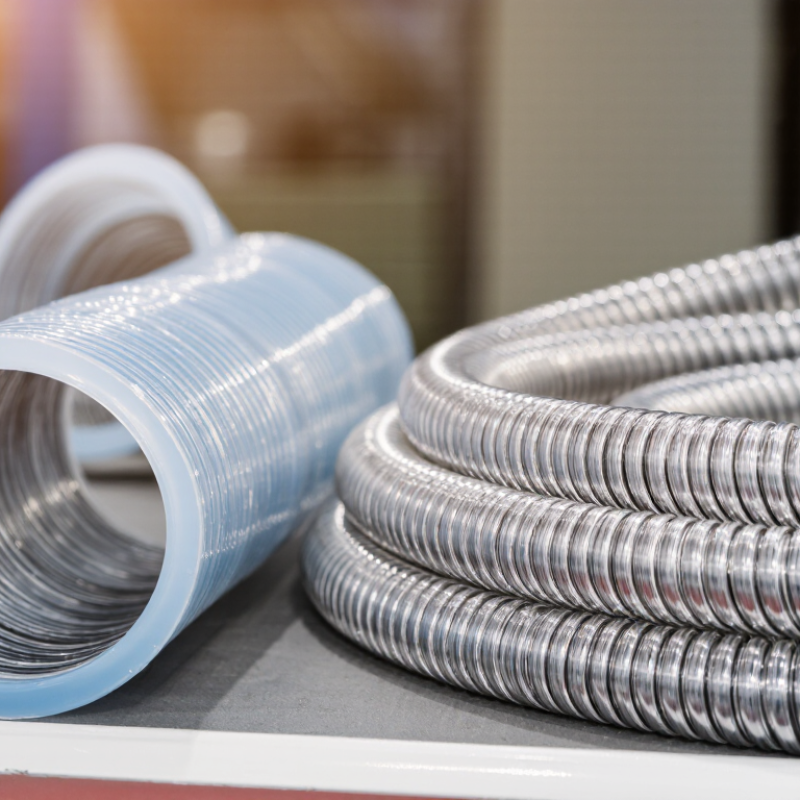
What Are the Top PVC Steel Wire Hose Types in 2026?

PVC Steel Wire Hose Anatomy: PVC Tube, Helical Wire, and Cover

A PVC steel wire hose is more than a clear tube with metal inside. Its performance depends on how the PVC tube, helical wire, and outer cover work together. The inner tube carries the material, while the wire spiral helps the hose resist collapse under suction and hold its shape during handling. Small details matter.

The tube’s wall thickness and smoothness affect flow and cleaning. A rough or damaged inner surface can trap residue, so inspect it under good light. The helical wire should sit evenly, without gaps or sharp points pressing through the PVC. It reinforces the hose, but it does not make it immune to kinking or crushing. Tight bends still cause trouble.

The outer cover faces abrasion, moisture, and contact with nearby equipment. Its resistance to sunlight, oils, or chemicals varies with the PVC formulation, so check the product’s stated service limits rather than assuming all covers behave alike. A transparent wall can make blockages easier to spot, though dirt and aging may reduce visibility. No single construction suits every job; hose diameter, temperature, pressure, and bend radius all deserve attention before selection.

General-Purpose Suction and Discharge Types: ISO 3994 Applications

General-purpose PVC steel wire hoses are designed to move liquids under suction or discharge, where a plain flexible tube may collapse. A steel helix helps the hose retain its shape during vacuum service, while the PVC wall provides a smooth path for water and other compatible aqueous materials. These are practical hoses for transfer lines, tanks, and equipment connections.

ISO 3994 covers helical thermoplastic hoses with textile reinforcement for suction and discharge of aqueous materials. A PVC hose with a steel helix may suit this application, but its construction and stated performance must match the relevant specification. Check the working pressure, vacuum rating, temperature range, and inner diameter before installation. A hose that looks sturdy can still flatten under excessive suction.

Details matter. A tight bend near a pump can restrict flow, and dragging a hose across rough concrete can wear its outer wall. Keep connections secure and inspect for cracks, soft spots, or exposed reinforcement. Compatibility deserves a second look, too: “general purpose” does not mean suitable for every liquid. ISO references are useful, but they do not replace the hose maker’s technical data. I sometimes find that overlooked.

What Are the Top PVC Steel Wire Hose Types in 2026? — General-Purpose Suction and Discharge Types: ISO 3994 Applications
Hose type Typical construction Common suction and discharge uses Suitable media (subject to compatibility) Selection considerations
General-purpose clear PVC wire-reinforced hose Flexible PVC wall with an embedded steel-wire helix; some products also have textile reinforcement. Transfer, suction, and discharge of water in utility, agricultural, and industrial service. Water and other aqueous liquids approved for the specific hose formulation. Check the product’s stated working pressure, vacuum rating, temperature range, and minimum bend radius. Clear walls can help with visual flow checks.
Heavy-duty PVC suction and discharge hose PVC tube and cover with a steel-wire helix, commonly combined with textile reinforcement; wall thickness and reinforcement vary by product. Pump connections, water transfer, and demanding general-purpose suction or discharge duties. Water-based fluids within the hose maker’s published compatibility limits. “Heavy-duty” is not a single standardized rating. Compare the manufacturer’s pressure and vacuum data at the intended temperature and hose diameter.
Material-handling PVC wire hose PVC tube with a steel-wire helix; tube formulation and reinforcement are selected for the intended material and service conditions. Suction or transfer of water carrying limited suspended solids, where the product is designed for that duty. Water with suspended particles only when the hose specification explicitly permits it. PVC wear resistance varies. For abrasive solids, verify abrasion data and inspect the tube regularly; a general-purpose hose may not be suitable for slurry.
Flexible, tight-bend PVC wire hose Flexible PVC construction with a helical steel-wire support; flexibility and allowable bend radius depend on design, diameter, and temperature. Mobile equipment and installations where routing space is limited and suction or discharge service is required. Approved aqueous liquids for the hose’s specific formulation and operating conditions. Do not bend below the stated minimum radius or kink the hose; either can restrict flow or damage reinforcement.
Application-specific PVC wire hose PVC hose with wire-helix reinforcement and a formulation or construction selected for a defined service. Specialized transfer duties, provided the hose documentation explicitly identifies the intended application. Only the fluids named or confirmed as compatible by the manufacturer. Do not assume chemical, food-contact, potable-water, or high-temperature suitability from PVC or wire reinforcement alone; look for the relevant approvals and test information.
Standards note: ISO 3994 specifies requirements for thermoplastic hoses with textile reinforcement and a thermoplastic cover for suction and discharge of aqueous materials. Confirm the applicable edition and the exact construction covered by a product’s conformity claim; a PVC hose with a steel-wire helix is not automatically compliant. The standard or hose category alone does not establish suitability for a particular fluid, pressure, vacuum, temperature, or application.

Heavy-Duty Vacuum Types: Check Size-Specific Vacuum and Pressure Ratings

Heavy-duty PVC steel wire hoses are built for suction work where a soft tube may collapse. A steel helix supports the PVC wall, but hose size changes how that support performs. Check the exact inside diameter before comparing vacuum ratings. A rating for a 25 mm hose does not automatically apply to a 75 mm version.

Look for vacuum and pressure figures listed for the specific diameter and temperature range. Vacuum ratings may be stated as negative pressure, percentage vacuum, or allowable pressure differential; these units are not interchangeable without conversion. Pressure capacity is a separate limit. A hose can handle modest positive pressure yet perform poorly under strong suction. Read the test conditions, too. Heat, tight bends, and wear can reduce working limits.

Fit matters on site. Measure the port, then check the hose’s actual inside diameter and minimum bend radius. At a dusty workshop extractor, a hose that kinks near a machine can restrict airflow even when its vacuum rating looks adequate. Keep the wire grounded where the application requires it, and inspect for crushed coils or cracked PVC. Ratings are useful, but they are not the whole story. I would still allow extra margin, especially when temperature fluctuates or the hose moves often.

Heavy-Duty PVC Steel Wire Hose: Size-Specific Vacuum and Pressure Ratings

Illustrative comparison for heavy-duty steel-wire-reinforced PVC hose sizes. Values are representative examples, not universal product specifications: actual ratings depend on hose construction, temperature, and service conditions. Check the exact size-specific manufacturer datasheet before selecting or operating a hose.

Food-Contact and Chemical-Transfer Types: Verify FDA 21 CFR 177.1520 Compliance

Food-contact and chemical-transfer PVC steel wire hoses can look similar, but their inner layers serve different duties. A “food-grade” label alone does not establish regulatory compliance. Verify the exact formulation and the intended food, temperature, and contact time.

Important detail: FDA 21 CFR 177.1520 addresses olefin polymers; it is not a blanket authorization for PVC hose. Ask the supplier to identify the applicable food-contact requirements for the hose’s actual materials and conditions of use. Get that in writing.

Request documentation for the finished hose, including its PVC compound, plasticizers, additives, and any liners or joining materials. Check whether the evidence covers repeated use, cleaning temperatures, and the foods you will convey, especially fatty or acidic products.

Inspect the inner bore and cut ends; exposed reinforcement, cracks, or persistent odor deserve attention. Small details matter. For chemical transfer, separately confirm compatibility with the specific chemical, concentration, and operating temperature. A food-contact statement does not prove chemical resistance, and a compatibility chart is only a starting point. It is easy to overlook real-world flexing. Recheck the hose after installation.

Operating Limits and Testing: Typical PVC Service Range Is −5 to +65°C; ISO 1402 Testing

PVC steel wire hoses are often specified for a typical service range of −5 to +65°C, but that range is not universal. The hose construction, working pressure, fluid, and exposure time all matter. In a cold workshop, a hose can stiffen near its lower limit and resist tight bends. Heat can soften the PVC and reduce pressure capacity. Cold changes everything. Treat the stated range as a selection guide, then check the manufacturer’s data for the exact hose assembly and application.

ISO 1402:2021 sets out hydrostatic test methods for rubber and plastics hoses and assemblies, including pressure testing. It does not establish one service-temperature range or one test pressure for every PVC wire hose. Test pressure and acceptance criteria depend on the relevant product specification. A useful inspection record should identify the hose, test pressure, hold time, and any leaks or visible swelling. Look closely at couplings, where movement and stress can concentrate. Small detail, big consequence. Pressure testing also cannot prove that a hose will remain suitable after repeated flexing, temperature cycling, or chemical exposure, so field checks still matter.

Copyright © 2025 The Toolroom Inc. All Rights Reserved.
Website Design St Louis by IQComputing