
Blog

Top 10 Detachable Sunroom Manufacturers in China

A Detachable Sunroom can turn a narrow patio into a bright, usable room, but its value depends on more than glass and appearance. Buyers need to compare frame materials, roof design, drainage, insulation, hardware, customization, and installation support. Small details matter. A poorly placed gutter or weak sliding-door track can become obvious after the first heavy rain.

Industry data offers useful context, though it does not measure sunroom demand directly. The 2023 Global Status Report for Buildings and Construction, published by UNEP and the Global Alliance for Buildings and Construction, estimated that buildings and construction accounted for 34% of global energy demand and 37% of energy- and process-related carbon dioxide emissions in 2022. This makes material choices and thermal performance worth examining, even for a compact extension. China’s Ministry of Housing and Urban-Rural Development reported that newly started prefabricated buildings reached about 630 million square meters in 2022, or 26.2% of new building construction. That figure describes a wider construction trend, not detachable sunrooms alone.

The manufacturers in this guide are assessed through practical factors: product range, fabrication capability, documented specifications, customization, and communication. Catalog photos help, but they cannot show every joint, seal, or delivery condition. Some specifications may also be difficult to compare across suppliers. Treat that as a reason to ask sharper questions, not to assume every product performs alike.
Top 10 Detachable Sunroom Manufacturers in China

## What Defines a Detachable Sunroom and Its Main Applications

What Defines a Detachable Sunroom and Its Main Applications

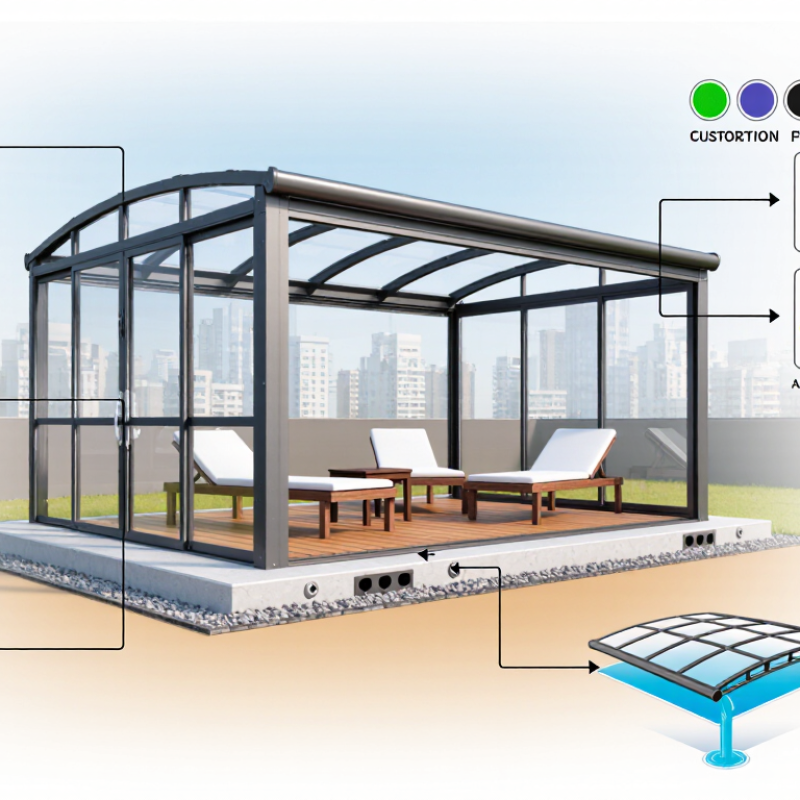
A detachable sunroom is a glazed, framed space designed for assembly, removal, and possible relocation. Bolted frame sections and replaceable wall panels often make disassembly easier than with a permanent addition. Detachable does not mean effortless. Wind exposure, drainage, and floor level still matter. On uneven patios, even small gaps can affect door movement and panel alignment.

Common applications include garden seating, café terraces, resort lounges, and event spaces. At a café, clear panels can shelter tables from light rain while keeping the outdoor setting visible. Homeowners may use one as a bright reading nook or seasonal dining area. Some spaces need sliding doors for easy access; others benefit from roof vents that release trapped heat. A sunroom can feel practical in mild weather, but poor ventilation may make it uncomfortable on warm afternoons. That detail is easy to overlook during planning.

Tips: Measure the usable floor area, not just the outer footprint. Check how doors open, where rainwater drains, and whether the panels can be reached for cleaning. Ask how the structure should be secured for local site conditions.

## How Chinese Detachable Sunroom Manufacturers Are Evaluated

Evaluating Chinese detachable sunroom manufacturers starts with evidence, not polished catalog images. Request drawings, material specifications, and project records for comparable climates. Check whether aluminum profiles, connectors, and roof panels have documented load and corrosion tests. A supplier should explain how its system handles wind, rain, drainage, and repeated assembly. Ask to see test reports, not just verbal assurances.

Thermal performance also matters. The 2024 Global Status Report for Buildings and Construction, published by UNEP and the Global Alliance for Buildings and Construction, estimates that buildings and construction account for 32% of global energy demand and 34% of energy-related carbon emissions. These figures cover the wider sector, not sunrooms alone, but they underline why glazing and shading deserve scrutiny. Compare stated U-values, solar heat gain data, and test conditions across suppliers. A low quoted value is not useful without its measurement basis. Even good paperwork can leave gaps.

Tips: Request a sample corner joint and inspect its seals, fasteners, and finish. Ask for a written installation sequence and after-sales response times. Compare the same opening size and glass specification in every quotation. Some manufacturers may have limited long-term data for detachable systems; note that uncertainty rather than assuming performance.

How Chinese Detachable Sunroom Manufacturers Are Evaluated

Suggested evaluation framework: the percentages show the relative importance assigned to each purchasing criterion, not survey results or ratings of specific manufacturers.

Assess structural and weather performance using documented specifications and test reports; compare materials, customization options, quality-control processes, delivery terms, and after-sales support before making a decision.

## Top 10 Detachable Sunroom Manufacturers in China

China’s detachable sunroom manufacturers serve projects ranging from compact garden extensions to wide terrace enclosures. Their products commonly use aluminum frames, insulated roof panels, and sliding glass walls. The details matter: check frame thickness, drainage channels, corner joints, and how panels lock together. A neat showroom sample may not reveal how the system handles wind-driven rain or repeated assembly.

A reliable Top 10 comparison should assess documented specifications, production experience, customization, and after-sales support—not promotional claims alone. Ask each supplier for installation drawings, material details, and photos of completed projects. Compare the same opening size and glass specification across quotations. Some manufacturers offer modular designs that simplify transport, while others rely on more customized fabrication. Neither approach is automatically better. One point buyers sometimes miss is whether replacement panels remain available years later. It is worth asking directly.

Tips: Request a written list of included components, including seals, fasteners, and flashing. Confirm who handles installation guidance and how damaged parts are replaced. If a quotation seems unusually complete, check every line; small omissions can change the final cost.

Top 10 Detachable Sunroom Manufacturers in China

Comparison guide: The entries below describe common detachable-sunroom product categories, not named companies or a verified manufacturer ranking. Product availability and specifications vary by supplier; confirm details directly before purchasing.

No. Product category Common frame material Typical enclosure options Detachable design feature Key details to verify with a supplier
1 Modular aluminum-and-glass sunroom Aluminum profiles Glass wall panels; glass or solid roof options Panelized components designed for assembly and disassembly Profile and glass specifications, drainage design, connection details, and installation requirements
2 Polycarbonate-roof sunroom Aluminum or steel frame Polycarbonate roof panels with optional glazed walls Roof and wall sections may be supplied as separate modules Panel type, UV protection, roof slope, water management, and replacement-panel availability
3 Retractable-roof sunroom Aluminum frame with a compatible track system Fixed glazing or movable roof sections Roof panels open or retract along a track, depending on the design Operating method, weather limits, drainage, maintenance access, and tested wind performance
4 Folding-panel sunroom Aluminum framing Glazed folding wall panels; roof options vary Connected panels fold to create a wider opening Panel stacking arrangement, hardware, threshold design, sealing, and opening clearance
5 Sliding-panel sunroom Aluminum framing Sliding glass panels with a fixed or separately operable roof Wall panels move horizontally on tracks and can be removed in some systems Track configuration, drainage, locking hardware, glazing safety requirements, and panel removal process
6 Freestanding modular sunroom Aluminum or galvanized steel frame Glass, polycarbonate, or mixed enclosure materials Independent structure assembled from multiple components Foundation or anchoring needs, structural calculations, site conditions, and local permit requirements
7 Wall-attached modular sunroom Typically aluminum framing Glazed walls with roof materials selected for the project Modular sections connect to a building wall and may be dismantled separately Wall-interface flashing, water sealing, load transfer, and compatibility with the existing building
8 Steel-frame sunroom Steel, often with a protective finish Glass or polycarbonate panels Bolted or otherwise demountable frame connections may allow disassembly Corrosion protection, connection design, coating maintenance, and structural documentation
9 Seasonal removable sunroom Aluminum or lightweight steel Removable panels; enclosure materials vary Designed for seasonal installation or removal, subject to the system design Storage requirements, repeat-assembly instructions, sealing performance, and permitted seasonal use
10 Custom-size detachable sunroom Material selected for the project Glass, polycarbonate, or a combination Components are configured to project dimensions and site conditions Approved drawings, tolerances, material specifications, delivery scope, warranty, and installation responsibility

## Comparing Manufacturers by Design, Materials, and Customization

When comparing detachable sunroom manufacturers in China, look beyond renderings. Ask for section drawings showing how roof panels, wall frames, and floor tracks connect. A clean joint matters. It can limit water entry and simplify seasonal removal. Request material specifications, not just “premium aluminum” or “insulated glass.” Frame alloy, coating thickness, glass build-up, and gasket type affect durability and comfort.

Glazing deserves careful comparison. The U.S. Department of Energy reports that heat gain and loss through windows account for about 25–30% of residential heating and cooling energy use. A sunroom’s exposure and climate change the result, so ask suppliers for glass performance data, including U-factor and solar heat gain coefficient. Compare thermally broken frames, roof shading options, and drainage details. A low price may omit these. Check the fine print.

Customization is practical when it solves a site constraint: a sloped patio, unusual opening, or limited storage space. Ask whether the maker can provide measured drawings, panel labels, and replacement hardware. Confirm the proposed module sizes before production; oversized panels may be difficult to carry through a narrow side passage. Also request installation tolerances and wind-load documentation appropriate to the project location. Not every catalog option is useful. A sample corner joint or finish swatch can reveal more than another polished image.

DOE reference: Energy Saver, “Update or Replace Windows.”

## Factors to Consider When Choosing a Manufacturer

Choosing a detachable sunroom manufacturer in China starts with the structure, not the brochure. Ask for drawings that show frame sections, connector details, roof pitch, drainage paths, and glazing specifications. Confirm how the design suits your site’s wind, snow, and temperature conditions. Request material descriptions and relevant test reports, and check that they match the proposed model. A polished sample is useful, but it cannot prove every joint will fit during installation.

Look for consistent production checks, clear packaging plans, and practical installation instructions. Ask how the manufacturer checks dimensions, protects glass during shipping, and handles replacement parts. Review lead times and warranty terms in writing, including exclusions. If possible, speak with past buyers about fit and after-sales support. I would not rely on a single factory visit or a low quotation; neither tells the whole story. Some details may still be missed, so leave room for questions.

Tips: Send the same drawings and specifications to each manufacturer. Compare itemized quotations, not just totals. Ask who will answer technical questions after delivery, and keep every agreed change documented.

Copyright © 2025 The Toolroom Inc. All Rights Reserved.
Website Design St Louis by IQComputing