Why Choose Super Intalox Saddle for Tower Packing?
Tower packing must create reliable gas–liquid contact without causing excessive pressure drop or flooding. Super Intalox Saddle is a shaped random packing used in absorption, stripping, and distillation towers. Its open geometry can support liquid distribution while leaving space for vapor flow. Actual results, however, depend on the tower and process—not the packing name alone.
The U.S. Environmental Protection Agency’s Packed-Bed/Packed-Tower Scrubber fact sheet (EPA-452/F-03-015) describes operating conditions such as liquid-to-gas ratio, pressure drop, and maintenance as important to scrubber performance. Perry’s Chemical Engineers’ Handbook, 9th edition, likewise provides established guidance for evaluating mass-transfer equipment and tower hydraulics. These references offer useful context, but they do not guarantee a particular Super Intalox Saddle efficiency. Not automatically.
In practice, engineers compare packing size, material, liquid load, vapor velocity, and the risk of fouling. A saddle may be attractive where flow capacity and effective wetting matter, yet poor liquid distribution can undermine its benefits. Even a good design needs verification. Pilot data, supplier specifications, and operating records help determine whether the packing suits a specific duty. This article examines those trade-offs, including capacity, pressure drop, installation, and material choice. A careful selection can improve tower operation; a rushed one may simply move the bottleneck elsewhere.
What Is a Super Intalox Saddle and How Is It Designed?
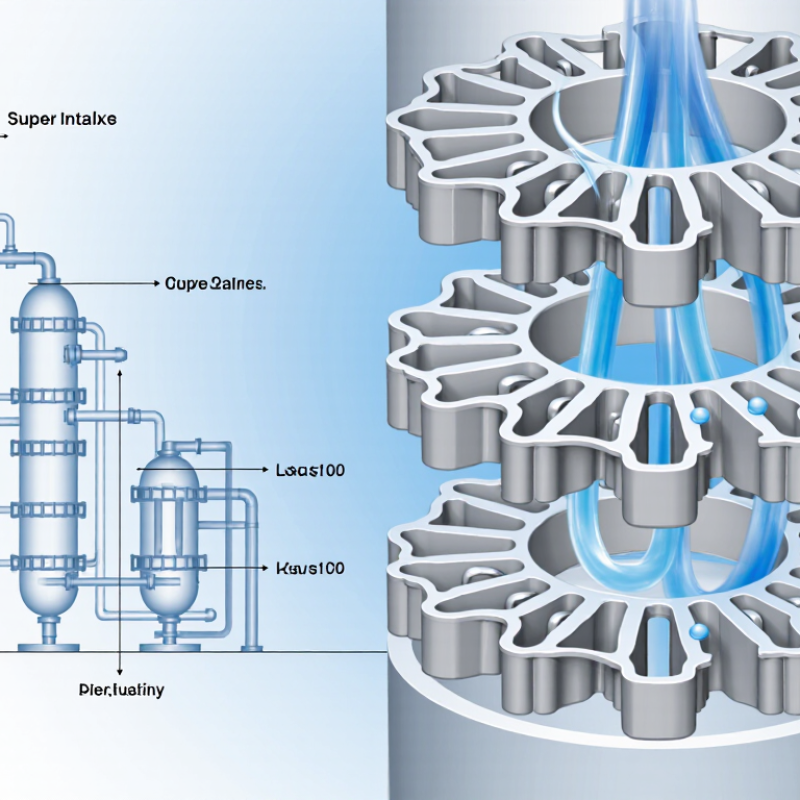
A super saddle is a random tower packing shaped like a curved, open shell. Its ribs and windows expose more surface to rising gas and falling liquid, while gaps between pieces help limit flow resistance. The geometry aims to balance wettable area, open volume, and strength. Small details matter. Perry’s Chemical Engineers’ Handbook, 9th edition (2019), reports specific surface areas of roughly 45–200 m²/m³ across common random-packing designs; the exact value depends on packing type and size, not the name alone.
In a packed column, liquid spreads over the saddle surfaces as gas passes through the voids. Curved edges and openings can interrupt smooth flow and encourage redistribution, but poor installation or uneven feed can still create dry zones. Real towers are less tidy than diagrams. The U.S. EPA’s Packed-Bed/Packed-Tower Scrubber fact sheet (2003) identifies pressure drop and liquid distribution as key design and operating checks. Engineers therefore compare packing dimensions, material, and column diameter against the service conditions, then verify performance using pressure-drop and mass-transfer data. A saddle’s shape helps; it cannot correct a badly designed distributor.
Why Choose Super Intalox Saddle for Tower Packing? - What Is a Super Intalox Saddle and How Is It Designed?
| Design or selection dimension | Description | Practical relevance in a tower |
| Basic form | A three-dimensional, saddle-shaped random packing element with a contoured surface and open passages. | The shape provides surface for liquid spreading while leaving pathways for vapor and liquid to flow through the packed bed. |
| Surface contour | Curves, ribs, or lobes are used to create surface area and promote liquid distribution across the packing. | Wetted surface supports gas–liquid contact; actual performance depends on the liquid distribution and operating conditions. |
| Open passages and void space | The element’s open geometry leaves interconnected spaces within a randomly packed bed. | Adequate void space helps gas and liquid pass through the bed; flooding tendency also depends on packing size, fluid properties, and loading. |
| Packing arrangement | Individual pieces are randomly loaded rather than aligned in a fixed, repeating pattern. | Careful loading and a suitable liquid distributor help reduce uneven flow and channeling. |
| Available material families | Saddle-style random packing is manufactured in materials such as ceramic, metal, and thermoplastics, depending on the product design. | Material choice should account for chemical compatibility, temperature, mechanical loading, and process conditions. |
| Mass-transfer service | Random saddle packing can be used in gas–liquid contacting operations, including absorption and stripping. | The appropriate packing depends on required separation, throughput, allowable pressure drop, and liquid distribution. |
| Pressure drop and capacity | These are system-level performance measures, not fixed values of the packing shape alone. | They vary with packing size and material, tower diameter, gas and liquid rates, and fluid properties; use design data for the selected packing. |
| Selection checks | Review packing dimensions, material compatibility, mechanical strength, bed depth, and the tower’s operating envelope. | Confirm hydraulic performance and distributor suitability with process-specific calculations or validated design data before selection. |
How Does Its Shape Support Mass Transfer in a Tower?
A saddle’s curved, open shape gives gas and liquid several routes through the packing bed. Its ribs spread liquid into thin films, while the open windows help gas pass across those wet surfaces. Contact matters. More contact can support faster mass transfer, provided the liquid distributes evenly and the tower operates within its design limits.
The U.S. EPA’s Packed-Bed/Packed-Tower Scrubber fact sheet reports typical gaseous-pollutant removal efficiencies of 95–99% for packed-bed systems. That is system-level data, not a guarantee for any packing shape. Saddle geometry can help by renewing liquid films and reducing dry zones, but poor irrigation can still create bypassing. Small details matter: a plugged distributor or uneven flow may erase the benefit. I would treat the EPA range as context, not a promise. The EPA’s Air Pollution Control Cost Manual likewise frames packed-bed performance around operating conditions and equipment design, not packing alone. More contact. Less bypass. Not magic.
Which Performance Benefits Distinguish It from Other Packings?
Why Choose Super Intalox Saddle for Tower Packing?
Which Performance Benefits Distinguish It from Other Packings?
Super Intalox saddle packing combines a curved profile with open passages. This geometry can promote liquid spreading while leaving room for rising gas. In suitable service, that balance supports efficient gas–liquid contact without excessive pressure drop. Compared with simpler ring shapes, its saddle-like form may also reduce stagnant zones and improve bed wetting. Small details matter.
Performance depends on more than shape. Packing size, material, liquid distribution, and operating load all affect capacity and separation. A well-designed bed can handle meaningful vapor and liquid flows, but poor distribution may erase much of the advantage. At high loads, pressure drop can still rise, and liquid may channel through the bed. That part is easy to underestimate. Selection should be checked against process conditions and material compatibility, not just a catalog rating.
Tips: Confirm the required packing size and material, then review pressure-drop and capacity data at your actual flow rates. Inspect the distributor design, too; even good packing cannot correct uneven liquid feed. During operation, compare pressure drop with the clean-bed baseline. A gradual change may signal fouling or distribution problems.
Saddle-shaped random packing is generally designed to promote efficient vapor–liquid contact while limiting flow resistance. The chart shows qualitative tendencies, not measured scores; actual performance depends on packing size, materials, column design, and operating conditions.
Where Is Super Intalox Saddle Packing Commonly Used?
Super Intalox saddle packing is commonly used in absorption and stripping towers, where gas and liquid need broad contact. Typical duties include acid-gas removal, process-gas washing, and chemical recovery in chemical and refinery operations. Its open shape can support gas flow while providing wetted surface for mass transfer. Performance still depends on tower design, liquid distribution, and operating conditions—not packing shape alone.
The U.S. Environmental Protection Agency’s Packed-Bed/Packed-Tower Scrubber fact sheet (EPA-452/F-03-015) reports 95–99% control efficiency for inorganic gases in some packed-bed scrubber applications. That figure describes the system, not a guaranteed result from any saddle packing.
Operators should check pressure drop, liquid loading, and fouling risk against the actual gas composition. A poorly distributed liquid can leave dry areas, even with suitable packing. Small details matter.
Saddle packing is therefore a practical option for many absorption duties, but it is not automatically the best choice for every tower.
What Factors Guide Its Selection and Installation?
Choosing a Super Intalox saddle starts with the process window, not a catalogue capacity figure. Estimate peak and turndown gas and liquid rates, then check pressure-drop limits, flooding margin, and liquid distribution. The U.S. EPA’s Packed-Bed/Packed-Tower Scrubber fact sheet (EPA-452/F-03-015, 2003) reports typical scrubber pressure drops of 0.5–1.0 inches of water per foot of packing. Treat this as context, not a rating for a specific saddle: gas properties and bed geometry change the result. A little caution helps.
Check for fouling, solids, corrosion, temperature limits, and solvent wetting before choosing material and size. Ample void space cannot prevent poor performance if liquid channels down one wall. Pilot data or validated hydraulic curves are especially important near capacity limits. Allow for turndown, too.
Installation is where design assumptions meet steel. Level the support grid, confirm the hold-down arrangement, and distribute packing evenly; avoid dropping pieces from height. Check distributor levelness and clean its orifices before startup. Verify bed depth and freeboard against the drawings, then wet the bed gradually. Watch for dry patches, unexpected pressure drop, or entrainment. Small defects show up fast. Record the packing depth and distribution checks so later troubleshooting relies less on memory.