
Buying Shock Absorbers across borders involves more than comparing prices or choosing a familiar brand. A Shock Absorber must match the vehicle, its suspension design, and the conditions it will face. A part that fits one model year may not suit another, even when the product photos look nearly identical. Small details matter. Buyers should confirm part numbers, dimensions, mounting points, load ratings, and whether the product is designed for the front or rear axle. They should also consider local road surfaces, climate, and typical vehicle loads. A unit used on smooth city streets may behave differently on rough roads or under frequent heavy loads.
Reliable sourcing takes clear questions and verifiable information. Ask suppliers how they check materials, production consistency, and finished-product performance. Request technical data, inspection records, sample units, and packaging details before placing a large order. Photos can help, but they are not proof. Compare warranty coverage, replacement procedures, lead times, minimum order quantities, and shipping arrangements in writing. Requirements for product documentation and import processes can vary by destination, so buyers should confirm them with qualified local advisers. A polished specification sheet is useful, yet it cannot answer every practical question. No checklist removes judgment. Sometimes a sample reveals a fitment issue that was easy to miss on paper. The following ten buying tips offer a structured way to assess product fit, supplier reliability, quality evidence, and total purchasing risk before committing to an order.
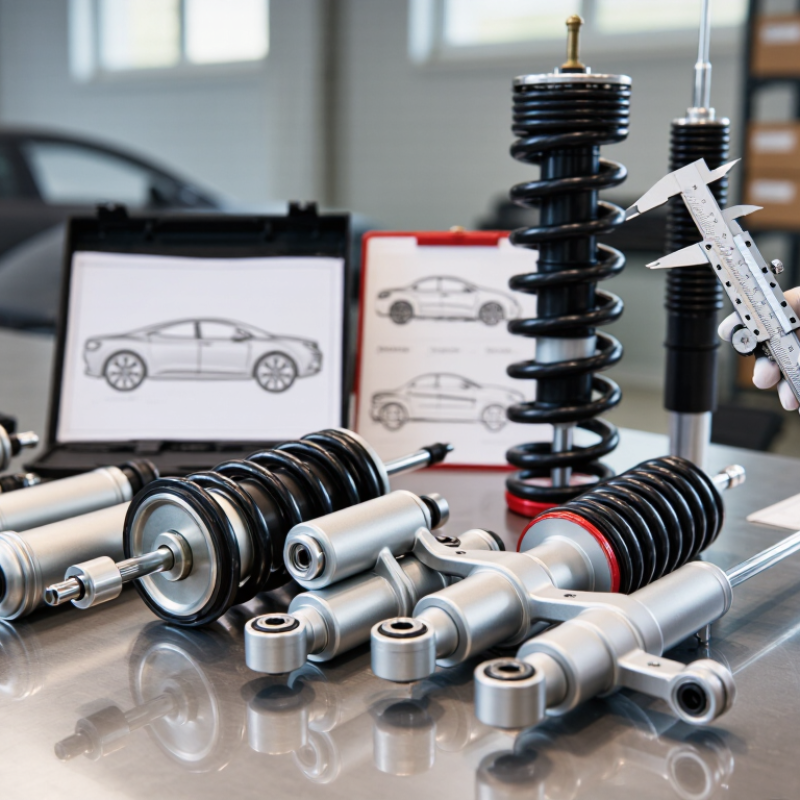
Before comparing shock absorbers, define the vehicle precisely. Record its make, model, year, body style, engine, and drivetrain, then check the existing part number or dimensions where available. Similar-looking vehicles may use different suspension setups. Small details matter.
Next, describe the load the vehicle carries in normal use. Include passengers, tools, cargo, towing, and any permanent modifications. A delivery van with shelving may behave differently from an empty one, even when both share the same model name. Check the vehicle’s rated limits and axle loads; do not assume a heavier-duty shock absorber increases the vehicle’s safe carrying capacity. That distinction is easy to overlook. I would also note whether the load is constant or changes from trip to trip.
Driving conditions help narrow the choice. Mention rough roads, frequent speed bumps, long highway journeys, steep routes, or regular off-road use. A short description is useful: “two occupants, 80 kilograms of tools, broken city pavement.” Ask the supplier to confirm compatibility against the vehicle details, expected load, and intended use. Photos of mounting points can help resolve uncertainty, but they should not replace fitment data. Be specific, and admit what you do not know.
Example loaded-mass build-up for a passenger vehicle. Confirm your vehicle’s actual weights and ratings before selecting replacement shock absorbers.
Illustrative calculation: a 1,500 kg vehicle plus four 75 kg occupants, 100 kg of luggage, and 50 kg of accessories gives a loaded mass of 1,950 kg. These are example inputs, not specifications for a particular vehicle. Check the owner’s manual or vehicle placard for gross vehicle and axle weight ratings, and describe your usual road conditions and load when choosing shocks.
Shock Absorber Buying Tips for Global Buyers
Check Shock Absorber Fitment and Technical Specifications
Shock absorber fitment depends on more than a vehicle’s make and model. Check the model year, engine, trim, axle position, and suspension type. A single vehicle range may use different parts across production years or markets. Confirm the vehicle identification details with a current parts catalog or the supplier’s fitment data. A familiar-looking mounting eye is not enough.
Compare the technical specifications before ordering. Check compressed and extended lengths, stroke, mounting style, and damping type. Confirm whether the unit suits a standard, sport, heavy-load, or electronically controlled suspension. Where relevant, ask for the connector details and operating voltage. Match the units carefully: millimeters and inches can be easy to mix up. One missed digit can mean a costly return.
Tip: Request a written fitment confirmation using the vehicle details and reference number. Compare the supplier’s datasheet with the original part, including its label and mounting points. Measurements can help, but they are not a substitute for verified application data. If details conflict, pause and ask. It is tempting to assume the old part was correct, but it may have been replaced before. Verify before purchase.
| No. | Buying Tip | Fitment and Technical Specifications to Check | Practical Buyer Check |
|---|---|---|---|
| 1 | Confirm the exact vehicle application | Check vehicle make, model, model year, market, body style, engine or powertrain, and drivetrain. Fitment can differ between versions of the same model. | Provide the vehicle identification number (VIN) or the full vehicle details, then confirm the application against a reliable parts catalogue or supplier fitment record. |
| 2 | Match the axle and installation position | Verify front or rear position, left or right where applicable, and whether the part is intended for a specific axle configuration. Front and rear units are not automatically interchangeable. | Check the position shown in the vehicle parts information and on the product documentation before ordering quantities for a complete vehicle. |
| 3 | Verify mounting style and dimensions | Compare the upper and lower mounting types, including eye, pin, stem, clevis, or other application-specific designs. Check bushing, sleeve, bolt-hole, and mounting-width dimensions. | Use a dimensioned drawing or measure the original unit and mounting points. Confirm that fasteners and bushings suit the vehicle; do not rely on appearance alone. |
| 4 | Check extended and compressed lengths | Compare the shock absorber's extended length, compressed length, and resulting stroke with the application requirements. Measurement reference points must be consistent, usually mounting center to mounting center. | Request the supplier's measurement method and dimensional drawing. Confirm that the unit will not bottom out at full compression or exceed its safe travel at full extension. |
| 5 | Confirm suspension and ride-height configuration | Check whether the vehicle has standard, heavy-duty, sport, off-road, self-levelling, or factory-lowered suspension. Aftermarket lift or lowering changes can affect required travel and compatibility. | State any suspension modifications, ride-height changes, or special equipment when requesting a fitment check. Confirm that the shock is approved for that configuration. |
| 6 | Choose the appropriate construction | Identify whether the application calls for a twin-tube or monotube design and whether it requires a gas-charged or other specified construction. Design alone does not establish vehicle compatibility. | Match the proposed construction to the vehicle requirements and intended use. Ask for the product specification sheet rather than assuming one design is suitable for every vehicle. |
| 7 | Review damping and load requirements | Check the specified damping characteristics, operating conditions, and intended vehicle load. A shock absorber controls suspension movement; it should not be treated as a substitute for a load-rated spring. | Describe normal and maximum operating loads, road conditions, and usage. Confirm the supplier's recommended application and do not infer performance from dimensions alone. |
| 8 | Compare part references and supersessions | Cross-check the original equipment reference, replacement reference, and any documented superseded numbers. A number match should still be checked against vehicle position and application details. | Request written confirmation of cross-reference and application coverage. Keep the reference list with the purchase order so the delivered part can be checked on receipt. |
| 9 | Check materials, protection, and operating limits | Review rod and body protection, seals, corrosion protection, fluid or temperature operating limits where specified, and any environmental or durability requirements relevant to the destination market. | Ask for published technical data and applicable test or compliance documentation. Check that packaging and corrosion protection are suitable for the shipping route and storage conditions. |
| 10 | Confirm inspection, warranty, and shipment details | Confirm product identification, production traceability, inspection criteria, warranty terms, packaging quantity, and the documentation supplied with the shipment. | Agree on acceptance criteria and required documents before ordering. On arrival, inspect part numbers, mounting details, visible condition, and quantities before installation. |
Shock absorbers should be compared by construction, not just price. Twin-tube designs often suit routine road use and offer compact packaging. Monotube units typically dissipate heat more effectively, which can help during repeated hard driving. Gas pressure may reduce foaming, but it does not guarantee better control. Check the specified damping range, stroke length, mounting points, and load rating against the vehicle’s actual use. Small details matter.
The International Energy Agency’s Global EV Outlook 2024 reports nearly 14 million electric car sales in 2023, about 18% of global car sales. As fleets diversify, buyers should verify that dampers match each vehicle’s weight and operating demands rather than assuming one specification fits all.
Materials shape durability. Inspect the piston rod’s corrosion protection, the body’s coating, seal compatibility, and bushing material. A polished rod can still fail early if its seal wears or road salt reaches exposed surfaces.
Ask suppliers for force-velocity curves and test results across relevant temperatures; a single showroom demonstration reveals little about fade after repeated bumps. Compare results from the same test method and load. One caveat: “heavy-duty” is not a measurable performance claim by itself. Request documented fatigue and corrosion testing, then confirm that replacement dimensions preserve the intended suspension travel.
A shock absorber can look flawless on a bench and still perform poorly after heat, vibration, and repeated compression. Ask for model-specific test reports, not a generic company brochure. Check force-velocity curves, leakage results, fatigue cycles, and the temperature range tested. The report should identify the tested part number, sample quantity, date, and acceptance limits. Small details matter. NHTSA’s 2022 Traffic Safety Facts reported 42,514 U.S. road deaths that year. This figure is not shock-absorber-specific, but it shows why vehicle components deserve documented quality checks. Do not treat a certificate as proof of road performance.
Verify that a supplier’s quality certificate is current and covers the actual manufacturing site and product scope. Confirm the issuing body independently, then compare the certificate’s address with the factory producing your order. Request batch traceability, inspection records, and a clear process for handling failed samples. If possible, test pre-shipment samples against the approved specification. One uncomfortable detail: a polished report may still describe a different production batch. Ask how routine production is checked, and look for dated records. If answers are vague, pause the purchase. The paperwork should match the part in the crate.
A low unit price can hide expensive surprises. Compare the landed cost, not just the quotation: shock absorbers, packaging, freight, insurance, customs charges, and possible storage fees. Ask suppliers to quote the same quantity and delivery term, then check whether prices include export packing and documentation. Small details matter. A damp carton or an unclear parts label can slow receiving and inspection.
Warranty terms deserve equal scrutiny. Confirm the coverage period, what counts as a defect, and who pays return freight and replacement shipping. Request written procedures for photos, test results, and claim deadlines. Ask how claims are handled when a failure appears after installation. A long warranty sounds reassuring, but vague exclusions can make it difficult to use. I would still verify the wording; comparison tables can miss the awkward details.
International freight can change the calculation. UNCTAD’s Review of Maritime Transport 2024 reports that over 80% of international trade in goods, by volume, moves by sea. That scale does not guarantee predictable delivery. Request carton dimensions, gross weight, pallet details, and a realistic dispatch window before booking transport. Compare ocean and air quotes against the cost of delayed inventory, not transit time alone. Leave room for port delays. A spreadsheet can still miss storage charges or local handling fees, so confirm those amounts with the forwarder before approving the order.
Copyright © 2025 The Toolroom Inc. All Rights Reserved.
Website Design St Louis by IQComputing