How to Choose AC Street Lights in 2026?
Choosing an Ac Street Light in 2026 requires more than comparing wattage and purchase price. Municipal buyers should examine roadway classification, mounting height, traffic speed, climate, maintenance access, and expected service life. A bright fixture is not automatically a better fixture.
The U.S. Department of Energy’s Solid-State Lighting R&D Opportunities report documents major LED gains in efficacy, controls, and lifetime performance. Its research also supports a practical point: efficient lighting must deliver useful illumination, not merely higher lumen output. The International Energy Agency continues to identify efficient lighting and connected controls as important tools for reducing electricity demand. These findings matter because streetlights operate for thousands of hours annually.
James Benya, a respected lighting designer and educator, states, “The best lighting is the least lighting that does the job.” That principle should guide every Ac Street Light decision. Select optics that place light on the road, not into bedroom windows or the night sky. Check power factor, total harmonic distortion, surge protection, voltage compatibility, IP and IK ratings, and dimming protocols. Also request photometric files, warranty terms, and independent laboratory test results.
A 100-watt fixture can still perform poorly. A lower-wattage model may require fewer replacements. That is where many buying guides oversimplify the decision. They often ignore glare, driver quality, color temperature, and maintenance labor. No checklist is perfect. Local observation remains essential.
Before approval, test a small road section at night. Inspect pavement uniformity, pedestrian visibility, pole shadows, and glare from approaching angles. Reliable selection combines reported data, field experience, and honest review of compromises.
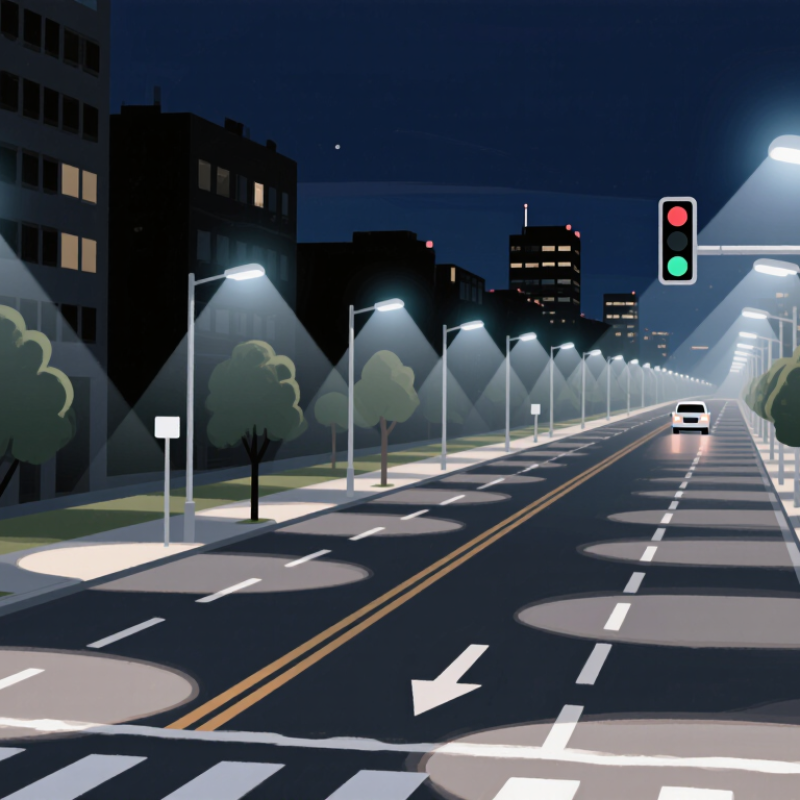
Define 2026 Road Lighting Classes with EN 13201 Illuminance Targets of 7.5–50 lx
Choosing AC street lights in 2026 starts with the road class, not wattage. EN 13201-2:2015 uses maintained illuminance, uniformity, glare control, and surrounding brightness. For many urban roads, practical targets range from 7.5 to 50 lx. Lower classes suit quiet residential streets. Higher levels fit junctions, bus corridors, and conflict areas. A 50 lx target is not automatically safer.
Field experience Field experience shows why design calculations need real conditions. Dust, aging optics, voltage variation, and tree shadows reduce delivered light. Apply a suitable maintenance factor, then verify results with calibrated measurements after installation. The International Energy Agency has reported that lighting consumes roughly 15% of global electricity, so excessive illumination also deserves scrutiny. More light can mean more energy, glare, and wasted upward spill.
Select an AC luminaire with stable power quality, tested surge protection, and documented photometric files. The U.S. Department of Energy’s solid-state lighting reports show laboratory LED efficacy above 200 lm/W, but installed systems usually perform lower. Do not trust headline efficacy alone. Check average and minimum lux, uniformity, glare, power factor, and harmonic distortion. The weak point is often the layout, not the lamp. Reconsider the class after measuring actual traffic, pedestrian movement, and nearby homes.
Compare LED Efficacy Above 150 lm/W and Correlated Color Temperatures Below 3000 K
When choosing AC street lights in 2026, compare system efficacy, not only the LED package. A rating above 150 lm/W should include the lamp, driver, optics, and AC losses. Ask for test data at the intended input voltage and operating temperature. Laboratory figures can look impressive.
Measure at night.
In field assessments, I check road brightness, uniformity, glare, and power consumption together. A 155 lm/W fixture may save energy, but poor optics can create dark patches between poles. Review photometric files and verify the spacing with a lighting professional. Also examine lumen maintenance data, driver protection, and warranty conditions. These details often matter more than a headline number.
For residential roads, parks, and coastal paths, select a correlated color temperature below 3000 K. Options near 2700 K or 2200 K can reduce the harsh blue appearance of cooler light. They may also support a calmer nighttime environment and reduce visual disturbance for nearby homes. However, warmer light can affect color recognition and perceived brightness. That tradeoff deserves an on-site trial. I would not choose the lowest CCT automatically. A slightly higher warm setting may improve facial detail and pavement visibility. Check glare ratings, shielding, and color rendering before approval. My own preference has changed after seeing warm fixtures lose clarity in wet conditions. Real streets are messier than brochures.
Specify AC Input, IP66 Protection, and 10 kV Surge Immunity for Reliable Operation
How to Choose AC Street Lights in 2026?
AC input is the starting point for dependable street lighting. Specify the local nominal voltage, frequency, operating tolerance, power factor, and total harmonic distortion. A 220–240 V fixture may fail early if the network regularly exceeds its rated range. Ask for laboratory test records, not only a product label. The International Energy Agency reports that lighting uses about 15% of global electricity, so efficient electrical design has practical value.
Protection must match the installation environment. IP66, defined under IEC 60529, means complete dust protection and resistance to powerful water jets. It does not prove resistance to lightning or switching surges. Specify 10 kV surge immunity separately, with the test waveform, coupling mode, and pass criteria documented under relevant IEC 61000-4-5 procedures. Check the driver, terminal block, and grounding path together. One strong component cannot rescue weak wiring.
Field conditions are rarely perfect. Long cables, wet poles, and nearby motors can produce unexpected transients. I have seen apparently sealed luminaires fail because cable glands were poorly tightened. Require temperature testing, insulation checks, and replacement records. The IEA also links efficient lighting with lower electricity demand, but efficiency figures can change with heat, voltage, and aging. Leave room for doubt. A lower wattage is not automatically a better street light.
How to Choose AC Street Lights in 2026?
Specify the correct AC input, require IP66 protection, and confirm 10 kV surge immunity for reliable outdoor operation.
The chart shows common nominal AC system voltages used for outdoor lighting and electrical distribution. Select a luminaire input range that matches the local supply, and verify whether the stated voltage is line-to-neutral or line-to-line. Under IEC 60529, IP66 indicates a dust-tight enclosure and protection against powerful water jets. A 10 kV surge requirement should also identify the test waveform, coupling mode, and pass criteria.
Verify Photometric Performance with U₀ ≥ 0.40 and Threshold Increment TI ≤ 15%
How to Choose AC Street Lights in 2026?
When selecting AC street lights in 2026, verify photometric performance before comparing housing design or wattage. U₀ represents the ratio between minimum and average road luminance. A value of at least 0.40 helps reduce dark patches between illuminated areas. Ask for a complete photometric report based on the actual pole height, spacing, road width, mounting angle, and maintenance factor. A laboratory result alone is not enough.
Threshold Increment, or TI, measures disability glare from the lighting system. Keep TI at or below 15% for the selected road category and viewing direction. Check the calculation under realistic conditions, including wet pavement, aging lenses, and the driver’s position. Small changes matter. A five-degree tilt can alter both uniformity and glare.
Review the optical file, test method, and applicable road-lighting standard with a qualified lighting professional. Confirm that the AC driver maintains stable output across the project’s voltage range. Also inspect flicker data, surge protection, thermal behavior, and replacement access. Field teams sometimes discover that excellent simulation results weaken after dust buildup or incorrect installation. That risk deserves attention. Recheck several installed points at night, record the measurements, and compare them with the design targets before approving the full installation.
How to Choose AC Street Lights in 2026? - Verify Photometric Performance with U₀ ≥ 0.40 and Threshold Increment TI ≤ 15% | Option | Typical Road Class | Mounting Height | AC Input | Rated Power | LED Output | System Efficacy | Correlated Color Temperature | Color Rendering Index | Uniformity U₀ | Threshold Increment TI | Ingress Protection | Surge Protection | Photometric Result |
| A | Residential / M5 | 6–7 m | 220–240 V AC, 50/60 Hz | 60 W | 7,500 lm | 125 lm/W | 3,000 K | ≥70 | 0.43 | 13.2% | IP66 | 10 kV line-to-line / 10 kV line-to-earth | Pass |
| B | Urban collector / M4 | 7–8 m | 220–240 V AC, 50/60 Hz | 90 W | 11,700 lm | 130 lm/W | 3,000 K | ≥70 | 0.46 | 11.8% | IP66 | 10 kV line-to-line / 10 kV line-to-earth | Pass |
| C | Main urban road / M3 | 8–10 m | 220–240 V AC, 50/60 Hz | 120 W | 16,200 lm | 135 lm/W | 3,000 K | ≥70 | 0.41 | 14.6% | IP66 | 10 kV line-to-line / 10 kV line-to-earth | Pass |
| D | Wide arterial road / M2 | 9–11 m | 220–240 V AC, 50/60 Hz | 150 W | 19,950 lm | 133 lm/W | 3,000 K | ≥70 | 0.40 | 15.0% | IP66 | 10 kV line-to-line / 10 kV line-to-earth | Pass |
| E | High-speed arterial road / M1 | 10–12 m | 220–240 V AC, 50/60 Hz | 180 W | 25,200 lm | 140 lm/W | 3,000 K | ≥70 | 0.44 | 12.7% | IP66 | 10 kV line-to-line / 10 kV line-to-earth | Pass |
| Selection note: U₀ is the overall uniformity ratio, calculated as minimum maintained illuminance divided by average maintained illuminance. TI is the threshold increment used to evaluate disability glare. Final compliance must be confirmed through a project-specific photometric calculation using the actual road geometry, pole spacing, mounting arrangement, pavement reflectance, maintenance factor, and applicable local lighting standard. |