
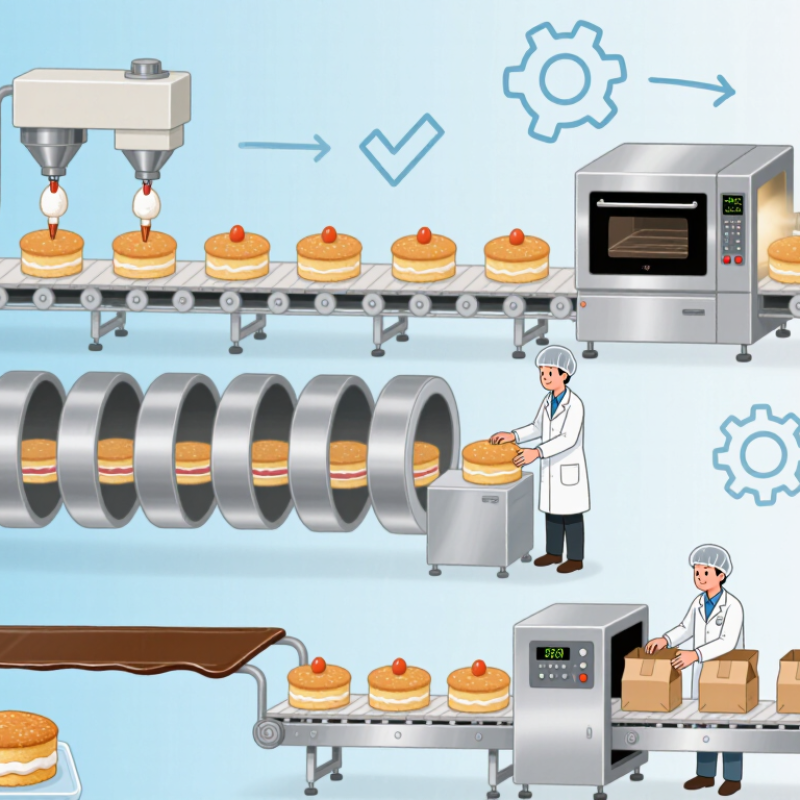
Choosing a Chocopie Cake Production Line requires more than comparing prices and advertised output. The line must match the recipe, factory space, labor skills, and expected market demand. A practical evaluation follows the product from mixing and depositing to baking, cooling, marshmallow filling, chocolate coating, and packaging. Each stage affects texture, appearance, and production stability.
Small details matter. A few degrees of baking temperature can change cake softness. Uneven filling may cause leakage during coating. Poor cooling control can create condensation inside packages. The selected equipment should offer accurate temperature control, consistent dosing, hygienic contact surfaces, and accessible maintenance points. Capacity deserves careful attention too. A line rated for high output may perform poorly when products vary in size or recipe. Real factory tests are more useful than impressive brochures.
Supplier experience also matters. Reliable manufacturers can explain material choices, cleaning procedures, spare parts, training, and after-sales support. Factory acceptance tests and sample production can reveal problems before installation. Independent technical advice may improve the decision, especially when energy use and future expansion are unclear. No machine fits every factory.
The first estimate may be wrong. That is normal. A responsible selection process reviews production data, operating costs, product quality, and worker safety together. This guide examines the main factors behind a dependable Chocopie Cake Production Line, helping buyers compare options with clearer expectations and fewer costly surprises.
How to Choose a Chocopie Cake Production Line?
Define Chocopie Cake Product Types and Production Requirements
Choosing a Chocopie cake line starts with defining the product, not comparing machine catalogs. Decide whether the cake will have a soft biscuit shell, marshmallow-style center, cream filling, or layered structure. Each type changes depositing accuracy, baking time, cooling space, and wrapping conditions. Record the target weight, diameter, height, moisture, filling ratio, and daily output. Small details matter. A two-gram filling variation can affect sealing and customer perception.
Production requirements should match the product’s physical behavior. Soft fillings need stable temperature control and precise depositing systems. Sticky centers may require anti-adhesion surfaces and easier cleaning access. The baking section should maintain even airflow, because uneven color often reveals poor heat distribution. After baking, the cooling conveyor needs enough length to prevent filling deformation during assembly. If coating is required, define its thickness and setting time before choosing the enrobing and cooling equipment.
Operators should also test the recipe under realistic conditions. Use actual flour, filling, coating, and packaging materials during trial production. Measure breakage, filling leakage, surface cracks, and weight variation. A line may look efficient on paper but perform differently with a soft center. This is where specifications need honest review. We once treated cooling space as a minor detail; later, product temperature caused wrapping problems. That mistake showed why production data, sanitation access, maintenance needs, and future capacity should be evaluated together.分分彩计划
| Product Type | Indicative Product Specifications | Core Process Steps | Production-Line Requirements | Key Quality Controls | Indicative Line Capacity |
|---|---|---|---|---|---|
| Standard round sandwich cake | Two soft cake shells; marshmallow-style filling; approximately 55–65 mm diameter, 18–25 g per piece, and 4–7 mm filling layer. | Deposit batter, bake shells, cool, deposit filling, assemble, set, coat with chocolate or compound coating, cool, and package. | Continuous oven with matched shell-forming depositor; cooling conveyor; accurate filling depositor; alignment and sandwiching unit; enrober and cooling tunnel. | Shell diameter and thickness, bake color and moisture, filling weight, sandwich alignment, coating coverage, and finished-piece weight. | About 150–400 pieces/minute, depending on product size, oven width, and packaging configuration. |
| Mini sandwich cake | Two smaller cake shells with filling; approximately 30–40 mm diameter and 7–12 g per piece. | Small-format batter depositing, baking, cooling, filling, assembling, coating, and high-count packaging. | Multi-lane depositor and forming system; precise low-volume filling heads; close-pitch transfer conveyors; coating and packaging equipment designed for small pieces. | Piece spacing, shell breakage, filling-to-shell ratio, coating consistency, and count or weight accuracy per pack. | About 250–600 pieces/minute; confirm capacity by lane count and pack format. |
| Large or thick-filled sandwich cake | Larger shells or a deeper filling layer; approximately 70–80 mm diameter and 30–45 g per piece. | Deposit and bake larger shells, cool thoroughly, apply a higher filling dose, assemble, stabilize, coat, cool, and package. | Higher-capacity batter and filling systems; longer cooling and setting sections; gentle transfer handling; enrober sized for the larger product. | Centering and stability of the filling, shell integrity, cooling before coating, coating pickup, and package protection. | About 100–250 pieces/minute, subject to oven capacity and the required cooling time. |
| Colored or flavored coating variant | Standard or mini sandwich cake with a formulated coating, such as a different color or flavor; coating thickness depends on the recipe and target weight. | Prepare and condition coating, enrobe or partially coat the assembled cake, cool to set, inspect, and package. | Coating preparation and temperature-control equipment compatible with the formulation; adjustable enrober; cooling tunnel; changeover and cleaning procedures for different coatings. | Coating viscosity and temperature, surface coverage, color consistency, setting, coating adhesion, and prevention of cross-contamination during changeovers. | Typically planned around the base cake format; actual rate may be limited by coating and cooling capacity. |
| Decorated or partially coated sandwich cake | Sandwich cake with a drizzle, patterned coating, or exposed cake surface rather than a full enrobing layer. | Form and bake shells, cool, fill and assemble, apply a controlled coating pattern, set, inspect, and package. | Accurate dosing or decorating head; stable product spacing; adjustable conveyor speed; inspection point after decoration; cooling capacity suited to the deposited coating. | Pattern placement, decoration weight, visual consistency, filling position, and damage during transfer and packaging. | About 80–250 pieces/minute for planning; decorative complexity and inspection needs can reduce the rate. |
Planning note: Product dimensions, weights, and line rates are indicative design ranges, not universal specifications. Confirm them with the target recipe, packaging format, shelf-life requirements, sanitation plan, and factory trials. Oven settings, cooling time, coating conditions, and throughput should be validated for the actual ingredients and equipment.