
Choosing China’s best Hydraulic Cylinder Parts supplier takes more than comparing prices. The right partner must deliver consistent dimensions, dependable materials, and clear inspection records. A piston seal that arrives slightly undersized can leak under pressure. A poorly finished rod may wear its seal too soon. Small details matter.
Fluid-power author Anthony Esposito’s practical teaching can be paraphrased this way: “A hydraulic component must match the system’s pressure, motion, and operating conditions.” This is not a verified verbatim quotation; it reflects the engineering principle behind careful parts selection. For buyers, that means checking drawings, tolerances, material specifications, surface finish, and production traceability before placing an order. Ask how samples are tested, and whether batch records are available. A polished catalog is useful, but it cannot replace evidence.
This guide examines how to assess Hydraulic Cylinder Parts suppliers in China, from seals and rods to pistons and gland components. It considers manufacturing capability, quality control, customization, communication, lead times, and after-sales support. It also separates useful signals from broad claims that are difficult to verify. Not every buyer needs the same supplier. Some need standard parts quickly; others need close engineering support for a demanding application. The comparison may still leave questions. That is worth admitting. Reliable sourcing depends on matching documented capability to your actual operating conditions, not simply choosing the lowest quote.
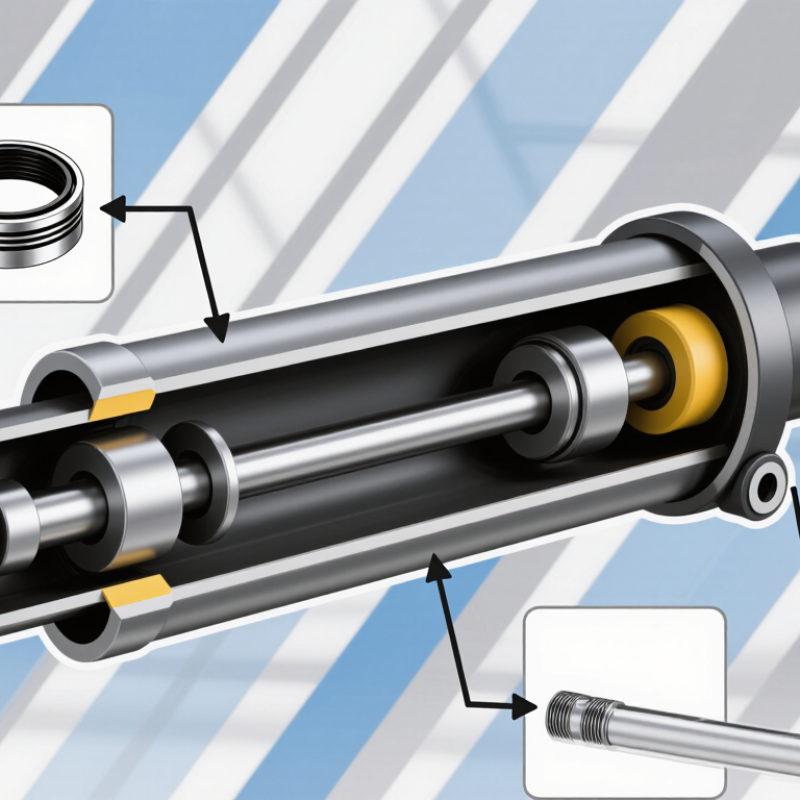
Hydraulic cylinder parts work as a pressure-control system, not as isolated pieces. The barrel contains pressurized oil, while the piston converts that pressure into linear force. The rod transfers force to the machine. Seals keep oil from bypassing the piston or leaking outside; wear rings guide the moving assembly and help prevent metal-to-metal contact. The end cap and gland close the cylinder, and ports route oil in and out. Some cylinders also use cushions to slow the piston near its travel limits. Small parts matter. A nick on a rod can damage a seal, causing a visible oil film and gradually weakening performance.
Fluid condition affects every part. ISO 4406 classifies hydraulic-fluid cleanliness using particle counts in three size bands: ≥4, ≥6, and ≥14 μm(c) per milliliter. This standard’s coding helps maintenance teams compare oil samples and set cleanliness targets; it does not, by itself, diagnose a failed cylinder. In workshop practice, technicians also inspect rod surfaces, measure wear, and check seals for hardening or extrusion. A clean-looking oil sample can still miss local damage. That is an important limitation. Parts should be selected for the cylinder’s pressure, stroke, mounting, and operating environment, not just its dimensions.
A hydraulic cylinder part can look correct on a shelf and still fail after installation. When evaluating a supplier, check material traceability, machining tolerances, surface finish, and documented inspection methods. For a piston rod, ask about coating thickness and corrosion testing, not just the quoted diameter. For seals and wear rings, confirm dimensions, material compatibility, and temperature limits against the cylinder’s working conditions. Small details matter. Request inspection records linked to specific part numbers or production batches.
A polished certificate is useful, but it cannot replace clear answers about how defects are handled. Ask how the supplier checks concentricity, removes burrs, and protects finished parts during shipping. A scratched rod or contaminated seal can create problems before the cylinder even enters service. Ask for sample reports and, where practical, inspect a sample part. I would not treat the lowest quote as proof of poor quality; neither does a low price prove value. Compare lead times, replacement procedures, and technical support alongside cost. Notice whether answers are specific—or vague.
| Evaluation criterion | Suggested weight | What to verify | Useful evidence | Potential warning signs |
|---|---|---|---|---|
| Engineering and application capability | 15% | Ability to interpret drawings, tolerances, operating pressure, temperature, mounting, and duty-cycle requirements. | A documented design review; clarification questions; drawings or samples checked against the supplied specification. | Accepting an incomplete specification without identifying assumptions or compatibility risks. |
| Material traceability | 15% | Whether material grades and batches can be traced to the parts supplied, where required by the specification. | Material certificates, batch or heat numbers, incoming-inspection records, and a documented link to the order or part lot. | Generic certificates with no identifiable connection to the supplied batch. |
| Manufacturing and process control | 15% | Control of relevant processes such as machining, honing, welding, heat treatment, coating, and assembly. | Process-control plans, equipment-maintenance records, operator qualifications where relevant, and inspection records for critical operations. | Uncontrolled subcontracting or inability to explain how critical dimensions and processes are monitored. |
| Quality management and inspection | 15% | Inspection planning, control of nonconforming parts, corrective actions, and calibration of measurement equipment. | Inspection reports, calibration records, nonconformance procedures, and—if claimed—an in-scope, current ISO 9001 certificate verified with its issuer. | A certificate presented as proof that every product meets every technical requirement, without product-specific inspection evidence. |
| Dimensional accuracy and interchangeability | 10% | Critical dimensions, fits, surface finish, and interface compatibility against the drawing or agreed standard. | A dimensional inspection report using identified measurement methods and clear acceptance criteria; first-article results for new parts. | Claims of “standard size” without a controlled drawing, tolerances, or inspection results. |
| Testing and performance verification | 10% | Tests appropriate to the part and its intended use, performed to agreed procedures and acceptance limits. | Part- or lot-specific test reports. For assembled cylinders, confirm the agreed pressure, leakage, and functional checks are documented. | Undocumented test claims or pressure values offered without reference to the design and applicable specification. |
| Seals and fluid compatibility | 8% | Seal material, dimensions, fluid compatibility, temperature range, and installation requirements for the application. | Seal material and compound identification, dimensional data, and relevant compatibility information. ISO 3601 may be relevant to O-ring dimensions when specified. | Substituting a seal material or profile without approval or documented compatibility review. |
| Cleanliness, preservation, and packaging | 5% | Protection against contamination, corrosion, and handling damage during production, storage, and transport. | Documented cleaning and packaging steps; cleanliness results if required by the specification. ISO 4406 can be used to code hydraulic-fluid particle contamination when applicable. | Open or damaged packaging, exposed machined surfaces, or cleanliness claims with no defined method or acceptance limit. |
| Delivery reliability and capacity | 4% | Quoted lead times, production capacity, order-change controls, and communication about delays or shortages. | A written production schedule, capacity information relevant to the order, and a clear escalation contact or process. | Unqualified delivery promises or repeated schedule changes without timely notice. |
| Documentation and after-sales support | 3% | Availability of clear part identification, revision control, installation guidance where needed, and a process for warranty or quality claims. | Controlled drawings or datasheets, packing lists, agreed certificates, and a documented claim-response procedure. | Unclear part revisions or no defined method to investigate and resolve reported defects. |
| Total suggested weighting | 100% | Treat standards and tests as applicable only when they match the part, design, and purchase specification. | ||
Suggested scoring: rate each criterion from 1 (insufficient evidence) to 5 (strong, verifiable evidence), then apply the listed weighting. The weights are a practical evaluation framework, not an industry-wide benchmark.
China’s Hydraulic Cylinder Parts Manufacturing Landscape
China’s hydraulic cylinder parts industry combines metal processing, heat treatment, sealing, and surface finishing across varied manufacturing regions. This connected supply base can support components such as piston rods, cylinder tubes, glands, and mounting eyes. Capabilities differ widely, though. A supplier with modern machining centers may still rely on outside partners for coating or specialized heat treatment.
For buyers, practical evaluation starts with the part drawing and its operating conditions. Ask how suppliers control rod straightness, bore finish, thread dimensions, and material traceability. Request inspection records tied to the actual batch, not only a sample report. Details matter. Check how defects are handled and whether process changes are recorded. A polished sample cannot prove consistent production.
Manufacturing depth is valuable, but it does not remove the need for verification. Compare measurement methods, production capacity, and communication about tolerances before placing repeat orders. For example, a rough-machined tube and a finished bore are not interchangeable inspection stages. Some suppliers may explain these limits clearly; others may need more precise questions. That distinction matters. And it takes time.
China Best Hydraulic Cylinder Parts Supplier?
How to Verify Supplier Quality, Capacity, and Compliance
Choosing a hydraulic cylinder parts supplier in China takes more than reviewing a catalogue. Ask for material certificates, dimensional inspection records, and test results tied to specific production lots. For a piston rod, compare the stated diameter, surface finish, and coating thickness with measured samples. Check whether measurement tools have current calibration records. Small gaps matter. A neat certificate alone cannot confirm consistent production.
Capacity needs evidence, too. Review machine lists, monthly output records, lead times, and how the supplier handles rejected parts. Request a sample inspection report showing bore dimensions, seal-groove tolerances, and pressure-test results where applicable. The ISO Survey 2022 recorded more than 1.26 million ISO 9001 certificates worldwide. That figure indicates broad adoption, not a guarantee of part quality. Confirm the certificate’s scope and validity, then compare the supplier’s controls with relevant requirements, including ISO 4413 for hydraulic systems. I would still want to see a real production record; an audit can miss a weak shift or rushed batch. Ask for traceability from raw material to finished part, and verify it against a sample order.
How to Choose a Supplier for Your Application
The right supplier is the one whose parts fit your pressure, duty cycle, and maintenance conditions—not simply the lowest quote. Grand View Research estimated the global hydraulic cylinder market at USD 14.4 billion in 2022, with projected growth of 4.3% annually from 2023 to 2030. This market context points to continued demand, but it does not prove a supplier can meet your specifications.
Start with the drawing. Confirm bore and rod dimensions, tolerances, surface finish, material grade, and seal compatibility. Ask how the supplier controls machining and inspects critical dimensions. For a cylinder exposed to abrasive dust, request evidence that the rod finish and wiper arrangement suit that environment. Fit matters most. A polished sample is not enough; request inspection records and test results for the production batch.
Check traceability, sample lead time, replacement-part availability, and how technical changes are documented. Ask whether parts are tested against your stated operating pressure and duty cycle, and clarify what the test does not cover. A lower unit price may hide longer downtime or inconsistent batches. It is worth reconsidering the specification, too: buyers sometimes request unnecessarily tight tolerances that raise cost without improving service life. Choose measurable requirements, then compare suppliers against them.
Copyright © 2025 The Toolroom Inc. All Rights Reserved.
Website Design St Louis by IQComputing