
stainless steel forgings sit behind many products that cannot afford hidden weakness. They support pressure equipment, energy systems, aerospace structures, marine hardware, and demanding industrial machinery. The International Stainless Steel Forum reported global stainless crude steel production of about 58.4 million tonnes in 2023. That scale signals strong demand, but it does not make every forging supplier equally dependable.
This guide examines seven stainless steel forgings manufacturers worldwide through practical criteria. These include alloy control, forging capability, heat-treatment consistency, dimensional accuracy, non-destructive testing, and material traceability. Certifications such as ISO 9001, ISO 14001, PED, or ASME-related approvals can strengthen confidence. They do not replace factory evidence.
Production details matter.
A reliable manufacturer should explain how it manages grain flow, forging temperature, solution annealing, and surface finishing. Buyers should also examine ultrasonic testing records, inspection plans, and representative delivery experience. The American Society for Metals highlights forging’s ability to improve structural integrity through controlled metal flow. However, that benefit depends heavily on process discipline and inspection quality.
Market reports from Grand View Research and Fortune Business Insights indicate continuing growth in forged components, supported by energy, transportation, and industrial equipment demand. Such forecasts are useful, yet they can simplify real purchasing conditions. Capacity figures may not reveal backlog, minimum order quantities, or technical responsiveness.
Therefore, this list is not a permanent verdict. A polished website proves little. The strongest candidates combine documented engineering practice, transparent quality systems, and repeatable delivery performance. Some manufacturers may excel in large rings, while others perform better with precision valve bodies or custom shafts. Readers should compare the shortlist against application requirements, applicable standards, and total lifecycle risk before choosing a partner.
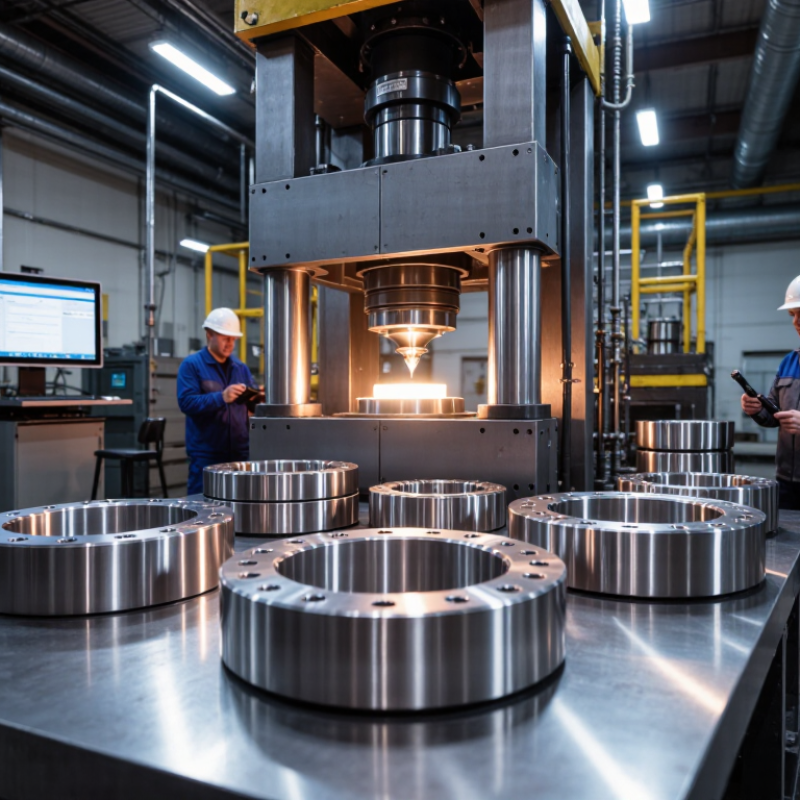
Selecting stainless steel forging manufacturers requires more than comparing prices or production capacity. ASTM A182 defines requirements for forged stainless steel flanges, fittings, valves, and pressure parts. It covers chemistry, tensile strength, heat treatment, and testing. A mill certificate should show the heat number, grade, and mechanical results. Small details matter.
EN 10204 strengthens document control. Type 3.1 certification links test results to the delivered batch. Type 3.2 adds independent or purchaser-side validation. That traceability becomes practical on a factory floor, where each forged ring needs a clear identity. The World Stainless Association reported approximately 58.4 million tonnes of stainless steel production in 2023. More volume increases the need for disciplined records, not weaker checks.
ISO Survey 2023 recorded more than 1.26 million ISO 9001 certificates worldwide. Yet certification alone cannot prove forging quality. Auditors should examine calibration logs, furnace charts, non-destructive testing records, and corrective-action evidence. In my experience, suppliers often present polished procedures but incomplete batch trails. That gap deserves uncomfortable questions. Ask whether ASTM A182 testing covers the exact grade and product form. Check whether EN 10204 documents match the purchase order. Review real samples, not only certificates. A strong manufacturer can explain deviations clearly, although no quality system is perfect.
Standards-based comparison of common stainless steel forging capability profiles. Company names and brand-specific claims are intentionally excluded.
| Rank | Anonymous Manufacturer Capability Profile | Typical Forged Products | Common ASTM A182 Grades | EN 10204 Documentation | ISO 9001 Quality Expectation | Key Verification Points | Typical Industries |
|---|---|---|---|---|---|---|---|
| 1 | High-integrity austenitic forging specialist Designed for corrosion-resistant pressure components and demanding process environments. | Flanges, forged fittings, valve bodies, rings, nozzles and pressure-retaining components. | F304/L, F316/L, F321 and F347. | EN 10204 Type 3.1 material certificate; Type 3.2 when purchaser and independent inspection involvement are specified. | Current ISO 9001 certification with documented control of purchasing, production, inspection and nonconforming outputs. | Heat-number traceability, chemical analysis, tensile testing, hardness testing, dimensional inspection and solution annealing records. | Chemical processing, oil and gas, water treatment, marine systems and general industrial equipment. |
| 2 | Duplex and super-duplex forging specialist Focused on high strength and chloride corrosion resistance. | Flanges, valve components, hubs, forged rings and subsea pressure parts. | F51/F60 for duplex 2205; F53 and F55 for super-duplex grades where specified. | Type 3.1 certificate normally includes heat treatment, mechanical properties and chemical composition; Type 3.2 may be required for critical service. | ISO 9001 system supported by controlled welding, heat-treatment and inspection procedures where applicable. | Ferrite balance testing, solution annealing control, impact testing where required, corrosion testing and complete traceability. | Offshore, subsea, desalination, petrochemical and marine applications. |
| 3 | Large-diameter ring and open-die forging producer Suitable for oversized components requiring controlled grain flow and dimensional stability. | Large rings, forged discs, hubs, shells, flanges and custom open-die parts. | F304/L, F316/L, F321, F347 and selected duplex grades. | Type 3.1 certificate with product chemistry, mechanical test results and heat-treatment information; Type 3.2 for contractually critical orders. | ISO 9001-based process control covering forging reduction, furnace calibration, inspection and final release. | Maximum outside diameter, wall thickness, forging reduction ratio, ultrasonic testing and dimensional reports. | Power generation, pressure vessels, industrial machinery, chemical plants and heavy engineering. |
| 4 | Precision closed-die forging producer Optimized for repeatable dimensions, near-net shapes and reduced machining allowance. | Valve stems, compact bodies, connectors, couplings, instrument parts and fittings. | F304/L, F316/L and other grades permitted by the applicable purchase specification. | Type 3.1 certificate with dimensional inspection records and batch traceability; Type 3.2 only when required by the order. | ISO 9001 certification with emphasis on process capability, gauge calibration and corrective-action control. | Dimensional capability, surface condition, machining allowance, die maintenance, hardness and material identification. | Instrumentation, sanitary equipment, food processing, medical equipment and industrial automation. |
| 5 | High-temperature stainless forging producer Focused on elevated-temperature service and stabilized or heat-resistant austenitic grades. | Turbine fittings, exhaust components, high-temperature flanges, rings and thermal-process parts. | F321, F347 and other ASTM A182 grades selected for the specified temperature and service conditions. | Type 3.1 certificate with heat-treatment cycle and mechanical-property data; Type 3.2 may apply to safety-critical equipment. | ISO 9001 quality controls with validated furnace monitoring and calibration records. | Solution-treatment temperature, cooling method, grain structure, intergranular corrosion testing where specified and dimensional stability. | Power generation, thermal processing, chemical production and high-temperature industrial systems. |
| 6 | Sanitary and hygienic forging producer Prioritizes cleanable surfaces, controlled contamination and smooth finishing. | Sanitary fittings, clamps, process connectors, pump parts and hygienic valve components. | F304/L and F316/L are common choices, subject to the customer specification. | Type 3.1 certificate with heat traceability, chemical composition and mechanical properties; surface-finish records may be added. | ISO 9001 system with documented cleaning, passivation, inspection and packaging controls. | Surface roughness requirement, passivation records, visual inspection, dimensional conformity and contamination prevention. | Food, beverage, pharmaceutical, biotechnology and clean-process industries. |
| 7 | Custom engineered forging and inspection partner Suitable for complex specifications, prototype-to-production work and third-party inspection. | Custom flanges, valve parts, forged adapters, rings, shafts and engineered components. | F304/L, F316/L, F321, F347, F51/F60 and other grades listed in the approved purchase order. | Type 3.1 as the standard independent manufacturer declaration; Type 3.2 when witnessed or validated by the purchaser and an independent inspection body. | ISO 9001 certification with contract review, design or drawing control, supplier evaluation and documented final release. | Inspection and test plan, non-destructive testing, third-party witness points, drawing revision control and full material traceability. | Engineering projects, infrastructure, energy, marine equipment and specialized process machinery. |