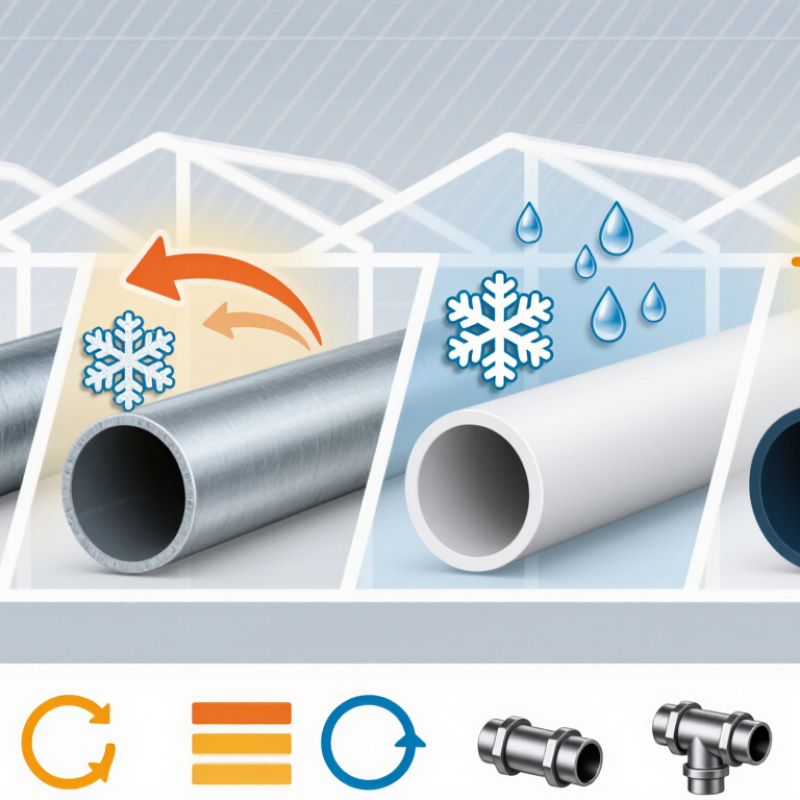
For global buyers, choosing the right Greenhouse Pipe affects structural safety, crop protection, and long-term operating costs. In 2026, suppliers offer galvanized steel, aluminum, PVC, and HDPE options for different greenhouse environments. Each material behaves differently under wind, snow, humidity, and repeated temperature changes. The strongest option is not always the most suitable.
Small details matter. A galvanized steel pipe may provide excellent load-bearing strength, but poor coating quality can invite rust around cut edges and welded joints. Aluminum resists corrosion and reduces installation weight, yet it may require stronger connectors in high-wind regions. PVC is economical for smaller structures, although prolonged sunlight can make lower-grade products brittle. HDPE offers useful flexibility, but its performance depends heavily on wall thickness and connection design.
Experienced buyers should examine pipe diameter, thickness, zinc coating, tensile strength, and supplier testing records. Ask for clear specifications, factory quality controls, and shipment documentation. Local climate data also matters more than a global product ranking. A pipe suitable for a mild coastal nursery may fail under heavy snow or desert heat. That assumption is often wrong.
This guide compares leading Greenhouse Pipe types for international purchasing decisions. It considers durability, installation, maintenance, transport, and total lifecycle value. Some cost comparisons remain imperfect because freight rates and regional labor prices change quickly. Still, careful technical review can reduce expensive mistakes and support safer, more productive greenhouse construction.
Greenhouse pipes form the hidden framework that keeps a growing space stable. They support the roof, side curtains, irrigation lines, heating tubes, and ventilation equipment. Without correctly selected pipes, even a well-designed greenhouse can sag, leak, or shift under strong wind.
Common choices include galvanized steel, aluminum, and PVC. Galvanized steel offers high strength for large structures and heavy snow loads. Aluminum resists rust and reduces structural weight. PVC is practical for water delivery and temporary systems, but it needs careful protection from sunlight and heat. Pipe diameter, wall thickness, coating quality, and connection design all affect service life.
Climate should guide every purchase. Coastal air can accelerate corrosion, while dry regions may expose pipes to intense ultraviolet radiation. A buyer should check load calculations, local building requirements, and available replacement fittings. Inspecting a cut section can reveal thin walls or uneven coatings. Small details matter.
Do not choose by price alone.
In practical installation, poorly aligned joints often create more trouble than weak pipes. I have also seen specifications look impressive while ignoring transport damage and repair access. That is a useful warning. A reliable pipe system needs suitable materials, accurate measurements, and realistic maintenance planning. Even the best pipe can fail when installers force mismatched connectors or leave standing water inside the line.
When comparing greenhouse pipes, start with the growing environment, not the lowest quotation. Galvanized steel offers strong load support for roofs, vents, and hanging systems. Aluminum is lighter and resists rust, but it may need thicker sections under heavy wind or snow. Stainless steel performs well in severe conditions, although its higher cost can challenge large projects.
Coating quality matters as much as base metal. Hot-dip galvanized pipes usually provide a thicker zinc layer than lightly coated products. Ask for coating thickness, adhesion results, and inspection records. Look closely at cut ends, welds, and threaded areas. These points often corrode first in humid houses. Powder coating adds color and another barrier, but poor surface preparation can cause peeling. It is not a magic shield.
Check the pipe wall thickness, outside diameter, and connection method together. A strong coating cannot repair an undersized frame. In coastal regions, salt exposure deserves extra attention. In fertilizer rooms, chemical resistance should be verified before purchase. Request samples and test them near irrigation lines for several weeks. Real site conditions can expose weaknesses that brochures miss. I have seen attractive coatings fail around scratched joints. That experience changed how I compare suppliers. Price still matters, but replacement labor matters too. Allow room for mistakes.
| Pipe Material / Finish | Typical Structural Grade or Specification | Typical Yield Strength | Common Coating or Surface Protection | Indicative Coating Thickness | Corrosion Resistance in Greenhouse Conditions | Relative Weight | Fabrication and Joining | Best-Suited Greenhouse Uses | Key Advantages | Main Limitations |
|---|---|---|---|---|---|---|---|---|---|---|
| Hot-Dip Galvanized Carbon Steel Pipe | Structural carbon steel with a zinc coating applied after fabrication; coating mass commonly selected to meet ISO 1461 requirements. | Approximately 235–350 MPa, depending on steel grade and tube specification. | Continuous zinc layer with sacrificial corrosion protection. | Typically about 45–85 μm per surface for many structural tube thicknesses; exact minimums depend on steel thickness and the applicable standard. | Very good | High | Welding, bolting, clamps, threaded fittings, and swaged or formed connections. Zinc fumes require proper controls during welding. | Primary frames, arches, columns, trusses, bracing, and high-load structures. | High strength, widely available, durable zinc protection, and good performance in humid environments. | Heavier than aluminum; cut or drilled areas may require zinc-rich repair treatment; surface appearance can vary. |
| Pre-Galvanized Steel Tube | Cold-formed or welded steel tube manufactured from galvanized sheet, often specified by zinc coating mass such as Z275. | Approximately 220–350 MPa, depending on the steel grade. | Factory-applied zinc coating before tube forming or welding. | For a 275 g/m² total coating mass, the nominal zinc thickness is approximately 20 μm per side, subject to standard and tolerance. | Good | High | Fast to cut and assemble with clamps or self-drilling fasteners. Welded edges and cut ends need additional protection. | Secondary framing, purlins, side rails, crop-support members, and light-to-medium duty structures. | Lower cost than many post-fabrication coatings; consistent factory finish; easy to process. | Welds, cut ends, and damaged areas have less protection than the original surface; generally less robust than hot-dip galvanizing after fabrication. |
| Powder-Coated Carbon Steel Pipe | Carbon steel tube with a cured thermoset powder coating over a prepared steel surface, normally with a corrosion-resistant primer system. | Approximately 235–350 MPa, depending on the underlying steel grade. | Polyester or epoxy-polyester powder coating; exterior-grade polyester is generally preferred for sunlight exposure. | Commonly about 60–120 μm for the complete powder layer; the specification should define the actual range. | Good to very good | High | Easy to fabricate before coating. Post-coating drilling, cutting, and welding require touch-up protection. | Visible frames, benches, trellis systems, doors, partitions, and structures where color and appearance matter. | Attractive finish, broad color selection, smooth surface, and good resistance to many fertilizers when properly specified. | Coating damage can expose steel; UV, abrasion, and chemical resistance depend strongly on resin type and pretreatment quality. |
| Zinc-Rich Painted Steel Pipe | Carbon steel protected by a zinc-rich primer and compatible intermediate or topcoat. | Approximately 235–350 MPa, depending on the steel grade. | Inorganic or organic zinc-rich primer, usually combined with an epoxy and/or weather-resistant topcoat. | System totals commonly range from about 100–250 μm, depending on the exposure category and paint system. | Very good when maintained | High | Can be fabricated before painting; repairs are practical with compatible zinc-rich materials and topcoats. | Large structures, coastal sites, areas requiring field repair, and projects with specified paint-system performance. | Flexible repair options, customizable protection, and strong performance when surface preparation is controlled. | Requires careful cleaning, application, drying, inspection, and periodic maintenance; poor preparation greatly reduces service life. |
| Aluminum Alloy Tube | Common architectural or structural aluminum alloys such as 6063-T5/T6 or 6061-T6; exact mechanical properties vary by temper. | Approximately 110–240 MPa, depending on alloy and temper. | Natural oxide film, anodizing, or exterior-grade powder coating. | Anodizing is commonly about 10–25 μm; powder coating is commonly about 60–120 μm. | Very good | Low | Extrusion-friendly; joined with bolts, clamps, dedicated connectors, or compatible welding procedures. Thermal expansion should be considered. | Lightweight arches, glazing bars, vents, doors, movable roofs, and corrosion-sensitive installations. | Approximately one-third the density of steel, naturally corrosion resistant, clean appearance, and easy handling. | Lower stiffness than steel for the same size; higher material cost; galvanic corrosion can occur when contacting dissimilar metals in moisture. |
| Stainless Steel Tube | Common austenitic grades include 304 and 316; grade selection should reflect chloride, fertilizer, and cleaning-chemical exposure. | Typically about 205–290 MPa minimum yield strength for common annealed grades. | Mill finish, brushed finish, electropolished finish, or passivated surface. | No applied metallic coating is normally required; protective performance depends on alloy and surface condition. | Excellent | High | Welding, orbital welding, clamps, and mechanical fittings. Weld discoloration should be cleaned and passivated where required. | Coastal greenhouses, hydroponic areas, fertilizer-handling zones, irrigation assemblies, and hygiene-sensitive components. | Excellent corrosion resistance, long service potential, cleanability, and strong performance in wet environments. | High purchase cost; chloride exposure can cause localized corrosion in unsuitable grades or poorly maintained surfaces. |
| PVC or uPVC Pipe | Rigid thermoplastic pipe selected by pressure class, temperature rating, and UV-stabilization requirements. | Not normally specified by yield strength for greenhouse structural design; stiffness and pressure rating are the controlling properties. | UV stabilizers, pigmentation, or an exterior protective layer; protection varies by formulation. | Not applicable as a metallic coating; wall thickness is selected by pipe class and application. | Good for water service | Very low | Solvent cement, threaded adapters, compression fittings, or mechanical couplings. Thermal movement and brittleness at low temperatures require consideration. | Irrigation lines, drainage, nutrient delivery, misting, and non-load-bearing utility systems. | Lightweight, low cost, electrically nonconductive, and resistant to many common water-treatment chemicals. | Generally unsuitable for primary structural frames; UV exposure, heat, impact, and chemical compatibility must be checked. |
| FRP or Fiberglass-Reinforced Plastic Tube | Glass-fiber-reinforced polymer profile selected by resin type, fiber direction, load, and environmental exposure. | Highly product-specific; design values commonly range from approximately 100–300 MPa in the principal fiber direction. | UV-resistant resin, gel coat, or an external veil layer. | Not normally specified as a metallic coating; protective surface layers are product-specific. | Very good | Very low | Bolting, bonded fittings, clamps, and specialized connectors. Drilling requires edge protection and suitable tools. | Corrosive irrigation zones, specialty structures, shade systems, and nonconductive applications. | Low weight, high resistance to many chemicals, and electrical nonconductivity. | Lower impact tolerance than steel, joining is less standardized, UV performance varies, and recycling can be difficult. |

| Buyer note: The values above are indicative engineering ranges rather than a substitute for a project specification. Final selection should verify local wind and snow loads, pipe diameter and wall thickness, welding or connection requirements, fertilizer and chloride exposure, UV conditions, drainage, coating pretreatment, applicable standards, and the manufacturer’s certified test data. | ||||||||||
Cold, snowy regions need strong greenhouse pipes before they need low prices. Hot-dip galvanized steel is usually suitable for main frames, arches, and purlins. Its stiffness helps resist snow accumulation and winter wind. EN 13031-1:2019 requires greenhouse structures to consider local snow, wind, and service loads. ASCE 7-22 also provides regional load guidance. A pipe that survives a mild test winter may fail under wet snow. That risk is often underestimated.
Hot, humid, and coastal climates create a different problem: corrosion. ISO 9223:2012 classifies atmospheric corrosivity using humidity, salt, and pollution exposure. Galvanized steel can work well, but damaged coatings need quick repair. Aluminum pipes reduce weight and resist rust, yet they generally need careful connection and deflection design. In salty air, corrosion-resistant steel or fiber-reinforced polymer sections may offer better service life. They cost more. Sometimes, that is the honest answer.
Dry, windy climates require lightweight but properly braced systems. Steel pipes remain practical when anchored deeply and protected against abrasion. Plastic pipes can suit small tunnels, temporary houses, or low-load sidewalls, but ultraviolet exposure can weaken them. The World Meteorological Organization reported that 2023 was about 1.45°C above the pre-industrial average. The IPCC also notes that heavy rainfall intensity rises by roughly 7% per 1°C of warming. Therefore, hot regions still need drainage, impact resistance, and stronger joints. Pipe selection should use site measurements, not climate labels alone. Forecasts remain imperfect.
Choosing greenhouse pipes starts with structural loads, not appearance. A 32 mm round galvanized steel tube may suit light seasonal tunnels, while 48 mm tubing offers better stiffness for wider spans. Actual sizing depends on bay width, wind exposure, snow depth, crop weight, and local engineering rules. Measure the site first. A pipe that looks strong can still buckle at a poorly braced joint.
Round pipes bend smoothly and shed water, making them practical for hoops and curved roofs. Square or rectangular sections simplify shelving, doors, and straight wall frames. They also provide easier mounting faces, but exposed corners can damage covering materials. For humid houses, prioritize wall thickness, zinc coverage, drainage, and corrosion resistance. Thin tubing saves money initially. It may age badly near fertilizer storage or coastal air. That trade-off needs a written inspection plan.
Connection systems should match tools, maintenance skills, and seasonal movement. Clamp fittings allow quick repairs and adjustable angles. Bolted sleeves create firm splices when alignment is accurate. Welded joints can be strong, yet field repairs become less convenient. Use compatible fasteners, remove sharp edges, and inspect every joint after heavy wind. I would not choose connectors from a catalogue alone. Test one small frame, record assembly time, and check looseness after rain, heat, and frost. Some assumptions will fail. Good selection leaves room to revise pipe spacing, bracing, and access points before full installation.
How to Choose Pipe Sizes, Shapes, and Connection Systems
How to read the chart: Larger outside diameters generally provide greater bending resistance for primary frames, while smaller tubes are commonly used for purlins, bracing, doors, and crop-support components. The values shown are representative nominal outside diameters of widely standardized metric steel tubes.
Selection guide: Round tubes are efficient for curved hoops and distribute loads evenly. Square or rectangular tubes simplify alignment and cladding attachment. Use slip-fit sleeves for fast field assembly, clamps or bolted connectors where adjustment is important, and welded joints for permanent rigid frames. Always verify wall thickness, steel grade, corrosion protection, local snow and wind loads, and regional tube standards before ordering.
For 2026 projects, pipe selection should begin with climate loads, not price. Hot-dip galvanized steel remains practical for frames, arches, gutters, and bracing. Aluminum suits humid areas, but its higher cost needs careful lifecycle analysis. PVC can support irrigation systems, yet it should not replace structural tubing without engineering approval. The World Steel Association’s World Steel in Figures 2024 reported 1,892.1 million tonnes of crude steel production in 2023. Supply is broad, but quality still varies sharply between mills.
Buyers should request EN 10204 3.1 inspection certificates, including chemistry, yield strength, tensile strength, and wall thickness. EN 13031-1 helps evaluate greenhouse structural design, wind loads, snow loads, and serviceability. For steel tubes, EN 10219, ASTM A53, or ASTM A500 may apply, depending on the profile and market. Check the exact scope. A familiar standard can still be the wrong standard. For corrosion protection, compare ISO 1461 or ASTM A123 requirements, and ask for measured zinc thickness, not vague “heavy galvanized” wording. ASTM A123 typically controls coating quality for fabricated steel products, while some pipe products follow different specifications.
In procurement practice, I also inspect weld seams, ovality, cut ends, and bundle traceability. Small defects become large problems after repeated irrigation, condensation, and temperature changes. Salt-spray results help comparison, but they cannot predict every greenhouse environment. I would require sample testing before a full container order. That step costs time. It can prevent an expensive frame failure.
Copyright © 2025 The Toolroom Inc. All Rights Reserved.
Website Design St Louis by IQComputing